
Review · JAPAN
Asakusa, Tokyo: Rickshaw Experience and Highlights Walking tour
Asakusa rewards slow looking. This 3.5-hour tour pairs the district’s best-known sights with a short rickshaw ride, giving you temple gates, old shopping streets, local food lanes, and photographs with Tokyo Skytree in view. I like the compact group size of up to eight people, and I like that the route includes more than the usual Kaminarimon and Senso-ji photo stop.
The main consideration is timing. The walk covers several busy areas, and the rickshaw route cannot be chosen in advance. The tour also leaves on time, ends at the starting point, and may run late, so you should not schedule a tight appointment afterward.
Key points at a glance
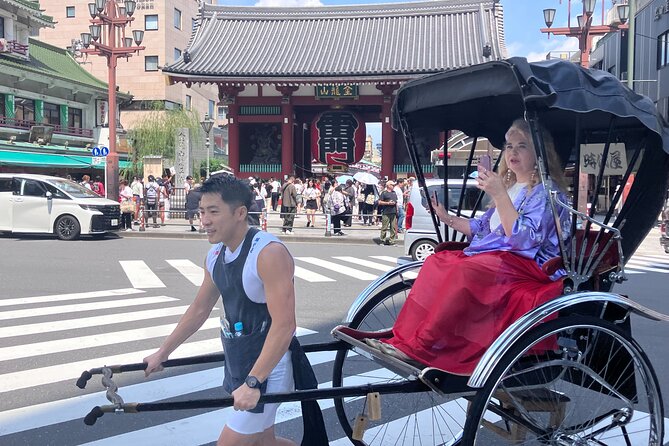
- A 20-minute rickshaw ride: You ride through eastern Asakusa, with possible Skytree views and photos along the way.
- Seven Asakusa stops: The route includes Kaminarimon, Nakamise, Senso-ji, Hanayashikidori, Nishi Sando, Hoppy Street, and the rickshaw section.
- A small group setting: The maximum is eight people, which should make it easier to hear the guide and ask questions.
- A guide-led introduction: Yoko is praised for adapting the walk to individual needs and suggesting other things to do in Tokyo.
- No admission fees at the listed sights: The temples, streets, and public areas do not require an entry ticket.
- Good advance planning matters: The experience is often reserved 47 days ahead, and its cancellation terms are strict.
Why this Asakusa combination works
Asakusa is one of Tokyo’s easiest districts for first-time orientation. The streets around Senso-ji bring together religion, food, shopping, amusement, and the everyday life of old downtown Tokyo. You can cover much of that area on foot, but a guide helps explain why each street feels different.
I like the balance here. You get the famous red lantern at Kaminarimon and the grand temple grounds, but you also pass through smaller lanes such as Asakusa Nishi Sando and Hanayashikidori. The rickshaw adds a distinctly Asakusa touch without taking over the whole experience.
At $35 per person, the price is reasonable if your priority is a guided introduction rather than a private, luxury ride. The listed sights are free, so your payment mainly covers the guide, organization, and the walking and rickshaw experience. Check the booking choice carefully, since the ride is described as an option and the rickshaw section has its own conditions.
The small maximum group is another point in its favor. Eight people is still enough for a social outing, but it is far more manageable than a large coach group. You should have a better chance of hearing explanations near Kaminarimon and Senso-ji, where crowds can make group movement difficult.
More Rickshaw Tours in Japan
- Tokyo Asakusa Rickshaw Tour
★ 5.0 · 1,375 reviews - Kyoto: Arashiyama Customized Rickshaw Tour & Bamboo Forest
★ 5.0 · 432 reviews - Kyoto Arashiyama Rickshaw Tour with Bamboo Forest
★ 5.0 · 354 reviews
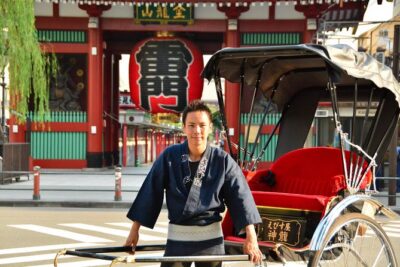
Starting at Kaminarimon’s giant red lantern
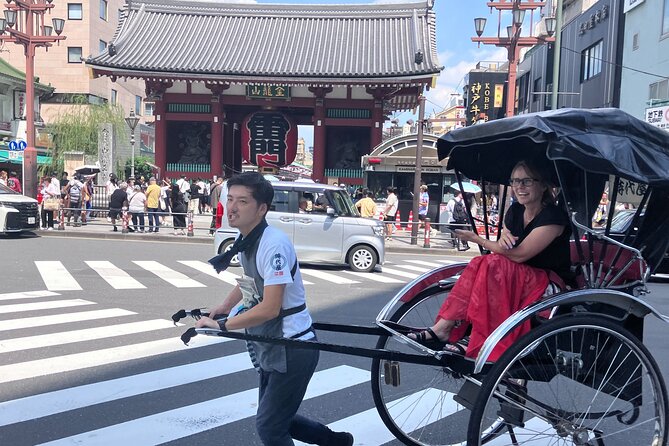
The meeting point is at 2-chōme-18-9 Kaminarimon, Taito City. This places you near the gate itself, so the tour begins in one of Asakusa’s most recognizable spots rather than with a long transfer from a railway station.
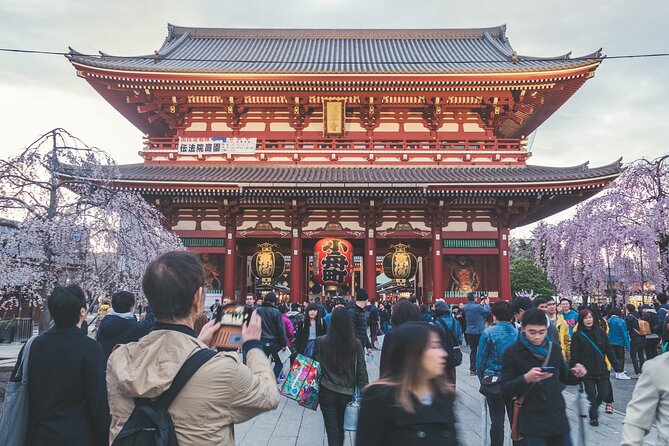
Kaminarimon means Thunder Gate. Its huge red lantern hangs between statues of Fujin, the wind god, and Raijin, the thunder god. The gate is a natural place to begin because it gives you an immediate visual introduction to Asakusa: bright color, religious symbolism, crowds, and the steady flow toward Senso-ji.
The scheduled stop is about 10 minutes. That is enough for an explanation and a few photographs, but not enough for an extended look at every detail. I would arrive early and take your first pictures before the group starts moving. Since the tour leaves at its departure time, a late arrival can mean joining after the opening explanation, and the lost time cannot be added to the end.
Walking Nakamise for 30 minutes
From Kaminarimon, you move along Nakamise Shopping Street, the approach to Senso-ji. This is one of the most enjoyable parts for anyone who likes traditional snacks, small souvenirs, and the visual rhythm of old-style storefronts.
The street can be crowded, so do not expect a quiet stroll. Its value is in the range of things packed into a short stretch. You may find Japanese sweets, small crafts, temple-related items, and gifts that are more distinctive than generic city souvenirs.
The 30-minute stop gives you time to look, listen, and get a sense of what you might return for later. I would resist making large purchases immediately unless you are certain you want to carry them for the rest of the walk. The tour continues through several streets, and your hands will be freer without extra bags.
No admission ticket is required for Nakamise. Food and shopping are not described as part of the tour price, so treat this stop as a chance to browse and plan your own purchases rather than as an included tasting session.
Senso-ji and the Kannon tradition
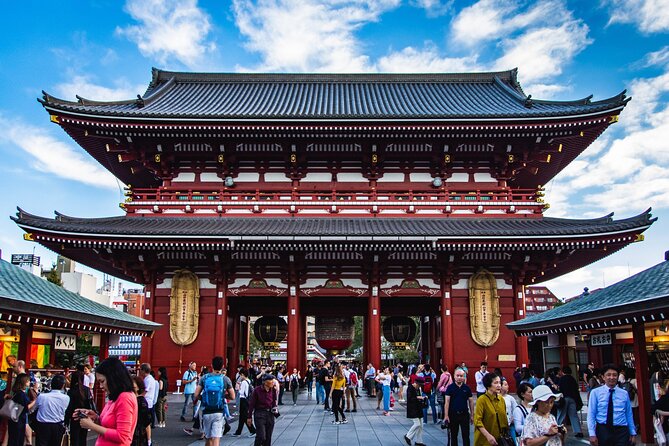
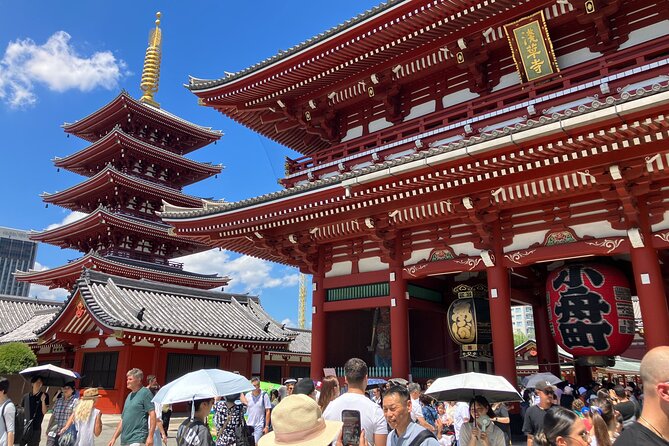
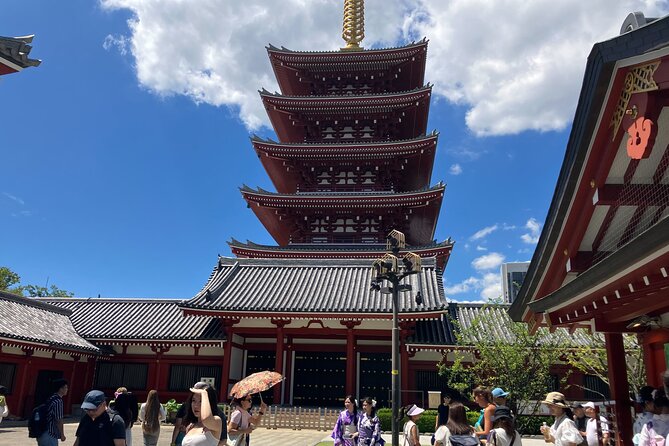
Senso-ji receives the longest stop, about 50 minutes. That makes sense. It is one of Tokyo’s oldest and best-known temples, dedicated to Kannon, the goddess of mercy.
The temple is not simply a backdrop for photographs. A guide can help you understand how the gate, approach, worship areas, and main temple setting fit together. The large scale also gives the group room to pause after the tighter shopping street.
You should expect other people here. Senso-ji is one of Asakusa’s main draws, and the most famous views can be crowded. A guide-led visit is useful because you do not have to work out the basic layout yourself. You can focus on the details around you and save a return visit for quieter exploration if you want more time.
The temple has no admission charge according to the tour details. The stop is still active rather than purely observational, so comfortable shoes and a moderate level of fitness are sensible.
More rickshaw tours around Japan:
- Kyoto Rickshaw Tour
★ 5.0 · 210 reviews - Tokyo: Asakusa Sightseeing Tour by Rickshaw
★ 4.9 · 195 reviews - Kyoto: Private Rickshaw Tour of Gion and Higashiyama Area
★ 5.0 · 144 reviews - Otaru Rickshaw Tour
★ 5.0 · 76 reviews
Hanayashikidori and old Tokyo atmosphere
Hanayashikidori is scheduled for 20 minutes. The street takes its name from Hanayashiki, identified as Japan’s oldest amusement park, and it carries a nostalgic side of Asakusa that differs from the formal temple approach.
Here you find shops, restaurants, cafes, snacks, and local specialties. The attraction is not one single landmark. It is the feeling of moving through a neighborhood where entertainment, food, and everyday shopping sit close to a major temple.
Twenty minutes is enough for a guided look, but not enough for a leisurely meal. If a shop or cafe catches your eye, note its location and return after the tour. This is one reason the walking route offers value: you get a preview of several parts of Asakusa without spending your whole day guessing which streets deserve your time.
Nishi Sando’s lantern-lit shopping street
Asakusa Nishi Sando, also called the West Approach, leads toward the west side of Senso-ji. The scheduled 30 minutes gives it almost as much attention as Nakamise, but the mood is different.
Wooden storefronts, lanterns, traditional crafts, snacks, and souvenirs give the street a quieter old-town character. It is a useful contrast with the main temple approach. You see how Asakusa’s identity extends beyond its biggest gate and most famous photographs.
I would use this stop to watch for small details rather than rush from shop to shop. The street is suited to browsing, and the guide can point out what is local or traditional. Since the tour is limited to roughly three and a half hours, you may want to mark places for a later return instead of trying to shop thoroughly during the group walk.
Hoppy Street and local pub culture
The 20-minute stop at Hoppy Street changes the tone again. This lane is known for izakayas, Japanese pubs, and Hoppy, a local drink often served alongside casual food such as yakitori and oden.
The street gives you a look at Asakusa after the temple visit, when the district shifts toward eating, drinking, and conversation. Its relaxed pub atmosphere is one of the more useful parts of the tour for anyone who wants to see local dining culture rather than only polished sightseeing spots.
The short timing is the limitation. Twenty minutes is not enough for a full meal or an unhurried evening at an izakaya. Think of this as an introduction and a possible dinner location. If you want to sample the food and drink properly, plan to return after the tour and confirm opening hours for yourself.
The 20-minute rickshaw ride toward Skytree views
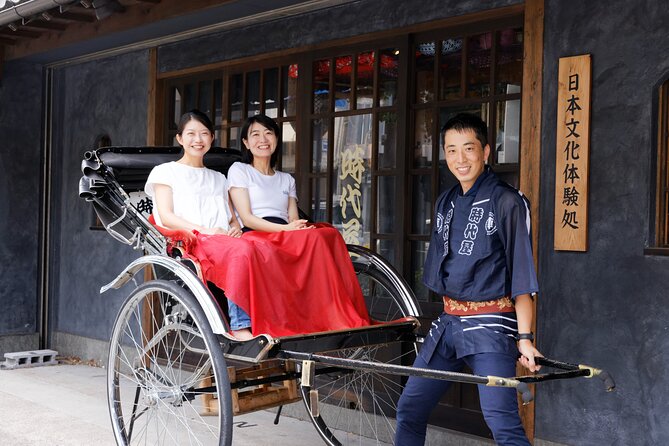
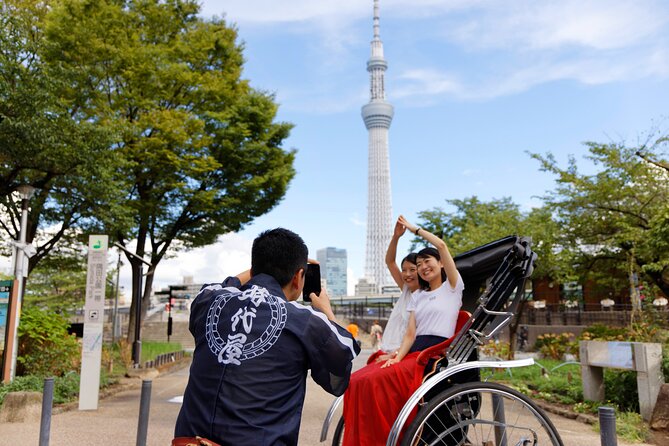
The rickshaw section is the tour’s signature feature. If you select the rickshaw option, you ride for about 20 minutes through eastern Asakusa. The route may include views of Tokyo Skytree, and the driver takes photographs intended to preserve the outing.
A rickshaw is a two-person vehicle. If you come alone, you ride alone rather than sharing with another customer. If you book as a pair, the arrangement is naturally suited to two people, though the specific vehicle assignment is organized according to the reservation.
There is an important limit: you cannot choose the rickshaw route. That keeps the experience flexible for traffic and local conditions, but it means you should not book expecting a guaranteed stop at one exact Skytree angle or landmark.
Follow the driver’s instructions during the ride. The rickshaw may not operate because of weather, traffic, or another operational issue, and the tour can be canceled in those circumstances. This is not a reason to avoid the experience, but it is a reason to keep your plans flexible.
The photographs are a practical benefit. You do not have to ask a stranger to take pictures, and the elevated seat can give you a different view of the streets. The ride is brief, so think of it as a memorable finish to the walking route rather than a full sightseeing circuit by vehicle.
Guide quality and the small-group advantage
The strongest personal praise attached to this experience goes to Yoko, who is described as tailoring the tour to individual needs and offering suggestions for other things to do in Tokyo. That kind of help matters in a district where a short walk can lead to many side streets, food stops, and temple details.
A good guide also helps with transitions. The route moves from the bright gate to the shopping street, temple, side lanes, pub street, and rickshaw. Without context, those stops can feel like a list. With clear explanations, you get a better sense of how religious life, commerce, food, and entertainment share the same neighborhood.
The group limit of eight supports that style of tour. You should still expect pauses while the group gathers and crosses busy areas, but the size is small enough for direct questions. If you have a particular interest in food, temple customs, or other Tokyo districts, ask early rather than waiting until the final stop.
Timing, fitness, and what to plan around
The listed duration is approximately three hours and 30 minutes. The itinerary adds up to a substantial amount of walking, standing, and time in crowded public areas, followed by the rickshaw ride.
You should have a moderate level of physical fitness. Wear shoes that are comfortable for several sightseeing stops, and arrive ready to stay with the group. The tour cannot be extended if you arrive late, and the end time can be delayed, so avoid booking a train, meal reservation, or airport transfer immediately afterward.
The tour begins and ends at the same meeting point. It is near public transportation, which makes it practical for fitting into a day in eastern Tokyo. The mobile ticket is useful for keeping your booking available on your phone, but you still need to be at the meeting point on time.
The experience is non-refundable and cannot be changed after booking. That strict policy matters more here because the rickshaw may be affected by weather or traffic. I would book only after your Tokyo schedule is firm.
Who should choose this Asakusa tour
I would recommend it to a first-time Tokyo visitor who wants a guided introduction to Asakusa without committing to a full-day city tour. It also suits couples or solo visitors who like the idea of a short rickshaw ride but want most of their time spent walking and exploring.
It is a good fit if you want:
- A mix of major sights and smaller streets
- A compact group instead of a large sightseeing crowd
- Help understanding Senso-ji and the surrounding district
- A short rickshaw ride with possible Skytree photographs
- Suggestions for other Tokyo activities from the guide
I would hesitate if you want a private itinerary, a guaranteed rickshaw route, a long ride, or a relaxed meal at Hoppy Street. The schedule gives you an excellent introduction, but each stop is a sample rather than a deep visit.
Should you book this Asakusa experience?
Book it if you want an efficient, friendly first look at Asakusa with a traditional rickshaw ride added to the temple and shopping streets. The $35 price is fair for the combination, especially with a maximum of eight people and a guide who may help shape the day around your interests.
Skip it if you prefer to explore at your own pace or need a fixed finish time. The route cannot be customized, the ride depends on conditions, and the no-refund policy leaves little room for last-minute changes. For most first-time visitors with a free half-day in Asakusa, though, this is a practical way to get oriented and leave with both useful ideas and memorable photographs.
FAQ
How long does the Asakusa tour last?
The tour lasts approximately three hours and 30 minutes.
Where does the tour begin?
It begins at 2-chōme-18-9 Kaminarimon, Taito City, Tokyo 111-0034, Japan.
Where does the tour end?
The activity ends back at the meeting point.
Is the rickshaw ride included?
The rickshaw ride is available if you book the rickshaw tour option. The ride lasts about 20 minutes.
Can I choose the rickshaw route?
No. The route taken by the rickshaw cannot be specified in advance.
How many people can join the tour?
The maximum group size is eight people.
What happens if I arrive late?
The group leaves at the scheduled departure time. If you arrive late, the tour cannot be extended, and the lost time will not be added later.
More Tours on Foot around Japan
- Kyoto Sagano Insider: Rickshaw and Walking Tour
★ 5.0 · 15 reviews - Kamakura Heritage Bike or Walk Tour with ex-Rickshaw guide
★ 5.0 · 11 reviews - Old Delhi Food, Heritage&Cultural Walk with Rickshaw ride to Masterji Kee Haveli
★ 5.0 · 742 reviews - 3-hour Old Delhi Heritage Walking tour with Rickshaw Ride
★ 5.0 · 240 reviews
More Tuk Tuk City Tours around Japan
- [30 minutes] Rickshaw tour around Asakusa [History, sightseeing, Tokyo Skytree]
★ 5.0 · 38 reviews - Tokyo: Asakusa Highlights Walking (OP : Rickshaw Experience)
★ 3.5 · 4 reviews - Otaru: Private Otaru Sightseeing Tour by Rickshaw
★ 5.0 · 4 reviews - Private Lisbon Sightseeing Tuk-Tuk Tour: Alfama, Belém & More
★ 5.0 · 4,277 reviews
Just added around Japan
- Sushi Making Tokyo with Traditional Rickshaw Ride Tour in Asakusa★ 5.0 · 12 reviews
- Exiting Rickshaw ride and Kimono experience★ 5.0 · 4 reviews
- Hot Spring Capital of Yufuin Rickshaw Tour★ 5.0 · 32 reviews
- Kyoto Sagano Insider: Rickshaw and Walking Tour★ 5.0 · 15 reviews
- Private 3-hour Kyoto Arashiyama Rickshaw Tour★ 5.0 · 5 reviews
- Kurashiki Rickshaw Tour★ 5.0 · 39 reviews
- Kamakura Heritage Bike or Walk Tour with ex-Rickshaw guide★ 5.0 · 11 reviews
- Rickshaw Tour of Kagoshima’s Historical and Cultural Sites★ 5.0 · 4 reviews
Rickshaw Tours, compared.

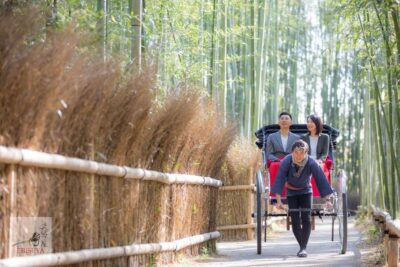
Arashiyama Customized Rickshaw Tour & Bamboo Forest
Read our review →
Split by Private Electric Rickshaw – Palace & Hidden Gems
Read our review →
Kyoto Arashiyama Rickshaw Tour with Bamboo Forest
Read our review →Browse the lists this tour appears in