Review · SPAIN
Tour Madrid in 2 hours! Electric Tuk – Fast, Fun, and Exclusive
Madrid moves fast, and this tour keeps pace. A private electric tuk-tuk carries up to four people through the city center and beyond, linking grand plazas, royal landmarks, museums, shopping streets, and the Santiago Bernabéu area in about two hours. I like the small private format and the chance to cover far more ground than you could on foot. I also like that guides such as Tadeo and Angel have been praised for local history, photo help, and friendly service.
The main drawback is time. With so many stops packed into two hours, this is mostly a scenic overview with short photo breaks, not a tour for extended visits inside Madrid’s monuments. You should also confirm the language before setting out, since English is offered, but one booking made for Italian reportedly received a Spanish-speaking guide.
Key points at a glance
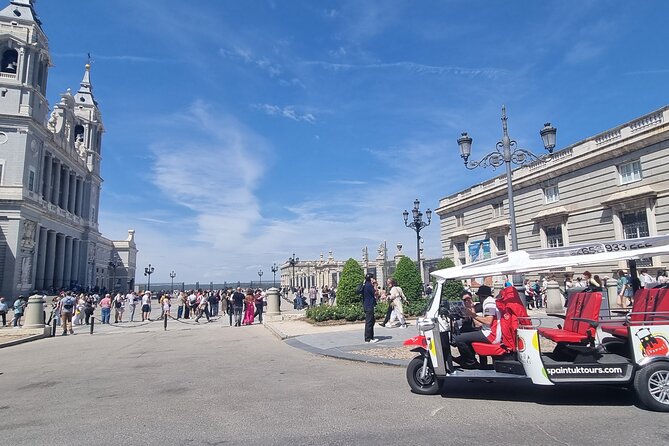
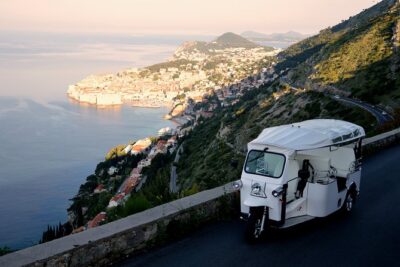
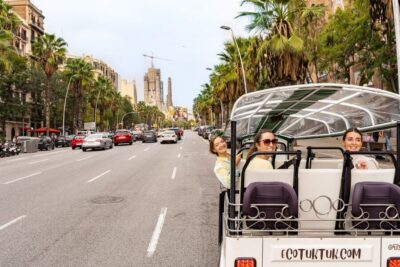
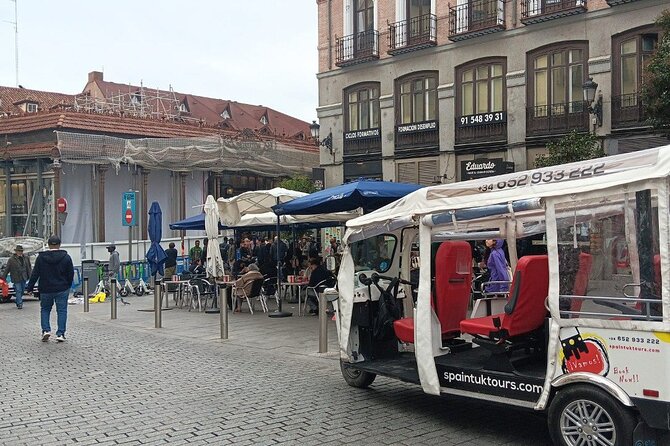
- Private electric tuk-tuk: Your group of up to four has the vehicle to itself, making this more personal than a large bus tour.
- Two hours across Madrid: The route connects the old center, Retiro area, Salamanca, the financial district, and major football and bullfighting landmarks.
- Best for first-day orientation: You get a quick look at many famous sights before deciding where to return on foot.
- Short stops matter: Most stops last five or ten minutes, so expect photos and commentary rather than full sightseeing visits.
- Royal Palace entry costs extra: The palace appears on the route, but its admission fee is not included.
- A few service concerns: Most feedback is highly positive, but one serious delay and one language mix-up show why clear confirmation matters.
What this Madrid tuk-tuk tour is really designed to do
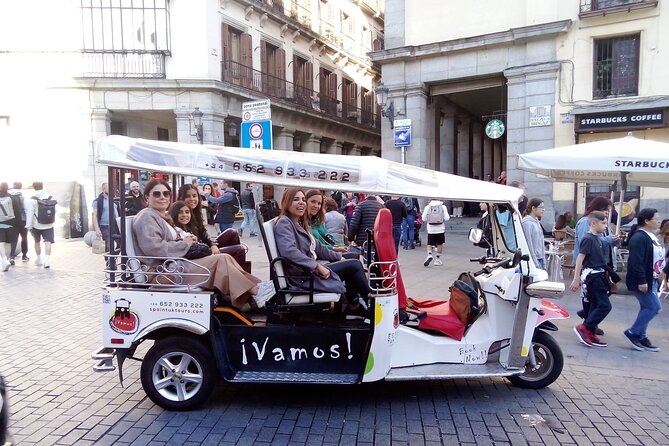
I would treat this as a city orientation, not a traditional two-hour walking tour. The route is broad and ambitious. It begins near Plaza de la Lealtad, close to the Prado Museum and Retiro area, then works through central Madrid before heading north along the grand Paseo de la Castellana.
That range is the appeal. In one short outing, you can see the Royal Palace, Plaza Mayor, Mercado de San Miguel, Puerta de Alcalá, Las Ventas, the Salamanca district, Santiago Bernabéu Stadium, Plaza de Cibeles, and Gran Vía. You will not have time to explore each one, but you can quickly learn how Madrid’s districts fit together.
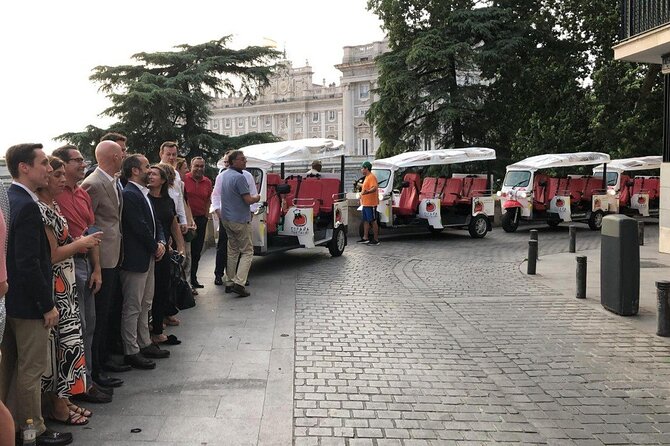
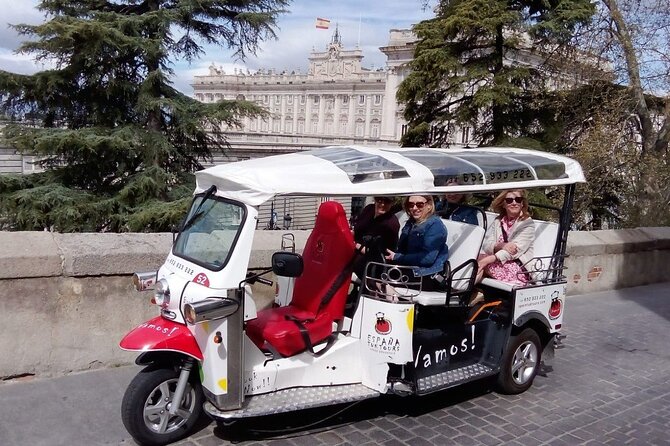
The electric tuk-tuk is useful here. Madrid’s central streets can be tiring when you are trying to cover several neighborhoods in a short time. A small vehicle also gets closer to the sights than a coach and keeps your group together without the formality of a big sightseeing bus.
The experience costs $215.07 per group of up to four. With four people, that works out to about $53.77 each, which is reasonable for a private two-hour outing. For one or two people, the per-person cost is much higher, so the value improves when you can fill the vehicle.
More Electric Tuk Tuk Tours in Madrid
- Madrid: Private City Tour by Eco Tuk Tuk
★ 4.9 · 3,465 reviews - Madrid Welcome Tour with Local Guide in Eco Tuk Tuk Private
★ 5.0 · 2,936 reviews - Madrid Historical Tour with Local Guide in Eco Tuk Tuk Private
★ 5.0 · 876 reviews
Plaza de Santa Ana and the old literary quarter
The opening stop is Plaza de Santa Ana, an open square in the Cortes neighborhood. It dates to 1810 and has changed shape several times as Madrid grew around it.
Five minutes is enough to get a first look and hear some background, but not enough for a long pause. The square is a good gateway to the city’s literary side, since the surrounding area connects with writers of Spain’s Golden Age.
The route also passes several places tied to Spanish literature. You may see the former home of Miguel de Cervantes, the author of Don Quijote, and the House of Lope de Vega on Cervantes Street. Lope de Vega bought that sixteenth-century house in 1610 and lived there until his death in 1635.
These homes are especially useful as landmarks for a later walking visit. The tuk-tuk does not give you time for a full guided house tour, so I would make a note of them if Spanish literature interests you.
Royal Madrid in a quick sequence
The Royal Palace is one of the tour’s headline sights. Construction began in 1738 after the old Habsburg palace burned on Christmas Eve in 1734. The new palace took seventeen years to build, and Carlos III moved in as his regular residence in 1764.
Spain’s royal family now lives at the Palacio de la Zarzuela, so the Royal Palace is used mainly for official ceremonies, receptions, and state events. It is also known as the Palacio de Oriente.
The stop lasts about five minutes, and admission is not included. That timing tells you exactly what to expect: an exterior view and a short explanation, not a palace visit. If you want to see the interior, plan a separate visit and budget for the ticket.
Nearby, the route includes the Almudena Cathedral and its museum. The cathedral was consecrated by Pope John Paul II in 1993 and became the first cathedral consecrated outside Rome. The museum contains objects connected with the Diocese of Madrid, including mosaics, episcopal shields, and religious ornaments across twelve rooms.
The museum admission is listed as free, but the schedule here allows about ten minutes. That is enough for a quick look if the stop is handled on foot, but you should not expect to study every room.
The Sabatini Gardens provide a more relaxed royal setting. They sit along the north side of the palace between Bailén Street and the San Vicente slope. The gardens cover about 2.66 hectares and are known for their formal layout and palace views.
The route also includes the Temple of Debod, an ancient Egyptian building relocated to Madrid. It sits west of Plaza de España near Paseo del Pintor Rosales, on a hill once occupied by the Mountain Barracks. The provided timing does not assign a fixed stop length, so I would expect a brief exterior view rather than a temple visit.
Plaza Mayor, San Miguel, and Madrid’s historic center
Plaza Mayor is the heart of Madrid de los Austrias, the old city associated with the Habsburg period. Its porticoed buildings surround a broad square that once hosted markets, public celebrations, bullfights, beatifications, and coronations.
The square began taking shape on the site of the old Plaza del Arrabal, where Madrid’s popular market operated in the late fifteenth century. In 1617, architect Juan Gómez de Mora was asked to bring a more uniform design to the buildings.
The ten-minute stop is well suited to photographs and a short orientation. You can look at the enclosed architecture, then use the location as a starting point for exploring the narrow streets of the old center later.
Mercado de San Miguel is another ten-minute stop. This covered market dates from around 1916 and contains food stalls, delicatessen products, and event space in an elegant iron-and-glass setting. It is a useful place to identify for a later snack or meal, but lunch and dinner are not included in the tour.
The route also passes the Royal Basilica of San Francisco el Grande, officially the Basilica of Our Lady of the Angels. It is in Madrid’s historic center and adds an important religious building to the city overview.
Again, the value is geographic. You see how the old center connects the royal district, the market, literary streets, and major churches. You will not have time to inspect every interior, so keep your camera ready and listen for places you want to revisit.
More Electric Tuk Tuk Tours in Spain
- Madrid Express Tour with Local Guide in Eco Tuk Tuk Private
★ 5.0 · 413 reviews - Madrid: Highlights City Tour by Electric Tuk Tuk
★ 4.7 · 346 reviews - Madrid Expert Tour with Local Guide in Eco Tuk Tuk Private
★ 5.0 · 220 reviews - Madrid Expert Plus Tour with Local Guide in Eco Tuk Tuk Private
★ 5.0 · 162 reviews
The Cortes district and Madrid’s art axis
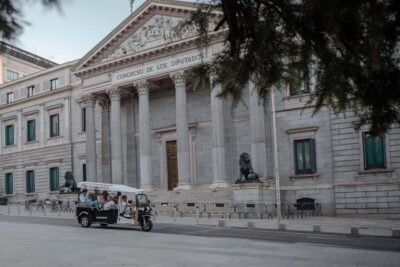
At Plaza de las Cortes, the tour reaches the building of the Spanish Congress. It was built on the site of the former Convent of the Holy Spirit, which served as the seat of Congress from 1834 to 1841.
The neoclassical facade has six fluted Corinthian columns and a triangular pediment decorated with reliefs by Ponciano Ponzano. The two lions beside the entrance were made by the same sculptor using iron from cannons captured during the war in Africa.
The ten-minute stop gives you time to see the facade and understand its place in modern Spanish government. The interior is not part of this short tour.
A few minutes away, Neptune Fountain marks the center of the Plaza de Cánovas del Castillo. The neoclassical fountain was proposed in 1777, built from 1782 to 1786, and depicts the Roman god Neptune.
The route then points toward Madrid’s major art institutions. The Prado Museum holds major collections of European painting from the sixteenth through nineteenth centuries, with especially important works by Velázquez, El Greco, Goya, Titian, Rubens, and Bosch.
The museum is an essential Madrid visit, but it is not an included interior stop here. I like seeing where it sits in relation to the other monuments, since that makes planning a separate museum visit easier.
The nearby Church of San Jerónimo el Real is popularly called Los Jerónimos. This late Gothic church with Renaissance influences dates in part to the early sixteenth century and has long connections with Spain’s monarchy. It was associated with royal retreats and investitures, and Alfonso XIII married there in 1906.
Puerta de Alcalá, Las Ventas, and Salamanca
Puerta de Alcalá is one of Madrid’s most recognizable monuments. Carlos III ordered it to replace an earlier gate, and architect Francesco Sabatini completed the current neoclassical structure in 1778.
It is often described as the first European triumphal arch built after the fall of the Roman Empire. Unlike many similar city gates, it has five openings instead of three. Its two facades differ, with the outer side carrying the larger decorative program and royal shield.
The five-minute stop is short but sensible. You can take photographs, hear why the gate has its name, and then move on without spending too much of the limited tour time.
Las Ventas follows. The bullring is described as Spain’s largest, with seating for 23,798 people and a ring measuring 61.5 meters across. Even if bullfighting is not part of your plans, the building is an important piece of Madrid’s public culture and architecture.
The tour then moves through Barrio de Salamanca, covering the principal streets of Velázquez, Ortega y Gasset, and Serrano. This is Madrid’s polished shopping and residential district, a sharp change from the narrow lanes around Plaza Mayor.
I find this contrast one of the strongest parts of the route. In a few minutes, you move from old city gates and bullring traditions to broad streets lined with upscale shops and formal buildings.
Bernabéu and the Paseo de la Castellana
The tuk-tuk continues toward Santiago Bernabéu Stadium, home of Real Madrid. The stadium opened on December 14, 1947, and its current capacity is listed as 81,044.
The stop is about five minutes, so this is an exterior look rather than a stadium tour. Football fans will likely want to return separately if they hope to see the interior or attend a match. Even a short stop helps you understand how far the central districts extend toward northern Madrid.
The drive along Paseo de la Castellana gives the route a different feel. This major avenue connects Salamanca with the Bernabéu area and Madrid’s financial district. It is a good section for simply watching the city change outside the vehicle.
Plaza Colón comes next, with its white marble Christopher Columbus monument and the nearby Gardens of Discovery. The monument, created by Jerónimo Suñol in 1885, measures 17 meters including its carved stone pedestal.
The National Library of Spain is also in this part of the city. The library preserves around thirty million publications produced in Spain since the early eighteenth century, including books, maps, prints, drawings, scores, and brochures. The building is not generally open for ordinary interior visits, so the tuk-tuk view is mainly architectural and geographic.
Cibeles, the Bank of Spain, and Gran Vía
Cibeles Fountain is one of Madrid’s most familiar public symbols. It shows the Roman goddess Cibeles seated in a chariot pulled by two lions, with the surrounding buildings including the Bank of Spain, the former post office palace, the Linares Palace, and Buenavista Palace.
The fountain is also a major celebration point for Real Madrid and Spain’s national football team. That gives the stop a useful modern connection, especially after seeing the Bernabéu.
The Bank of Spain building receives only an exterior mention. Its interior is normally limited to educational groups, universities, and certain nonprofit cultural organizations, so you should not expect to enter during this tour.
The route finishes its city panorama along Gran Vía, Madrid’s major commercial and entertainment street. Built in the early twentieth century, it runs from Calle de Alcalá to Plaza de España and helps tie together the historic center, shopping districts, cinemas, restaurants, and traffic routes you have seen along the way.
Timing, guides, and possible service problems
The private format is the clearest advantage. Only your group participates, and the vehicle holds up to four people. That allows you to ask questions and request photo help without waiting for a large crowd to gather.
The strongest guide feedback centers on personal service. Tadeo was praised for showing important places and taking photographs. Angel, described as a friendly Venezuelan guide, was also praised for useful explanations, patience, and help after a GPS problem caused a late arrival.
There is one important warning. A booking for two tuk-tuks at 2 p.m. reportedly involved a delay of about forty minutes and several phone calls before the vehicles appeared. Another booking made for an Italian-language tour encountered a Spanish-speaking guide instead. Those cases may not represent every departure, but they make it sensible to confirm the meeting point, time, vehicle count, and language before the day begins.
The meeting point is Pl. de la Lealtad, 1, in the Retiro district. The activity returns there at the end. Mobile tickets are accepted, English is offered, service animals are allowed, and the tour is near public transportation.
Who should book this two-hour Madrid overview?
I would recommend it most strongly for first-time visitors who want to get their bearings quickly. It is also a good fit for families or small groups who would rather ride than walk between far-flung districts, and for anyone with limited time in Madrid.
It suits people who enjoy seeing many landmarks from the outside and choosing later stops based on what catches their interest. The private setting also works well for a group of four, when the price becomes much easier to justify.
I would not choose it as my only Madrid sightseeing experience. The stops are too short for the Royal Palace, Prado Museum, Bernabéu Stadium, or the literary houses. Think of the tour as a moving introduction, then reserve separate time for the interiors that matter most to you.
Free cancellation is available up to 24 hours before the start time. Inside that window, the amount paid is not refunded, and changes are not accepted.
Should you book this electric tuk-tuk tour?
Book it if your priority is covering Madrid efficiently in a private vehicle, with a guide who can connect major sights and help with photos. A full group of four gets the strongest value, and the route is particularly useful early in a Madrid stay.
Skip it if you want long museum visits, palace interiors, or a slow food-focused experience. The tour is fast by design. For the right audience, that is its strength, but you should board expecting a lively city overview rather than fifteen full excursions.
FAQ
How long is the Madrid electric tuk-tuk tour?
The tour lasts approximately two hours and returns to the original meeting point.
How many people can join one tuk-tuk?
The private tour is for a group of up to four people.
What language is offered?
English is offered. One booking reported receiving a Spanish-speaking guide despite requesting Italian, so you should confirm the language before the tour.
Is Royal Palace admission included?
No. The Royal Palace appears on the route, but its admission fee is not included.
Where does the tour start and finish?
It starts at Pl. de la Lealtad, 1, Retiro, 28014 Madrid, and ends back at the meeting point.
Can I cancel for a full refund?
Yes, if you cancel at least 24 hours before the experience start time. Cancellations or changes made within 24 hours are not refunded.
More 2-Hour Experiences in Madrid
- 2 Hour Private Panoramic Tuk Tuk Tour
★ 5.0 · 8 reviews - Madrid: Tour with Tuk Tuk Zero: The Best of Madrid in 2h 15min
★ 4.9 · 8 reviews - Madrid Highlights: Tuk-Tuk Tour w/pick up (2 hours)
★ 5.0 · 5 reviews - Discover Porto’s Highlights on a 2-Hour Private Electric Tuk Tuk
★ 4.5 · 1,860 reviews
More Electric Tuk Tuk Tours around Madrid
- Tour Madrid: Secrets in a Electric Tuk Tuk
★ 4.6 · 155 reviews - Christmas Lights Tour of Madrid in Eco Tuk Tuk Private
★ 5.0 · 125 reviews - Madrid: Private Christmas Lights Tour by Eco Tuk-Tuk
★ 4.8 · 63 reviews - Madrid: Discover the City by Private Electric Tuk Tuk
★ 4.6 · 62 reviews
Just added around Madrid
- Tuk Tuk Tour with Wine Test in Madrid★ 3.8 · 6 reviews
- Tuktuk historical tour of Madrid 1 Hr in a fun and original way★ 4.1 · 4 reviews
- Tuk-tuk Tour: Private tour of downtown Madrid★ 4.0 · 2 reviews
- Tuk-tuk tour of downtown Madrid★ 5.0 · 2 reviews
- Discover Madrid in a Fun & Eco-Friendly Tuk-Tuk – Private Tour★ 4.0 · 4 reviews
- Eco Friendly Tuk Tuk Experience with the Local in Madrid★ 5.0 · 4 reviews
- Tour of Castizo Madrid with a private guide in a yellow Tuk-Tuk★ 5.0 · 26 reviews
- Tuk Tuk Tour of the Best of Madrid (booking only)★ 5.0 · 2 reviews
Electric and Eco Tuk Tuk Tours, compared.
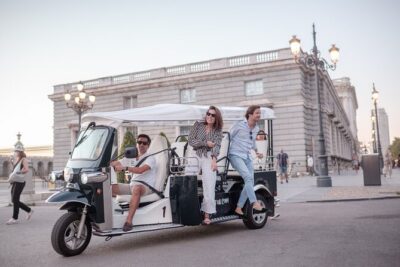
Madrid Welcome Tour with Local Guide in Eco Tuk Tuk Private
Read our review →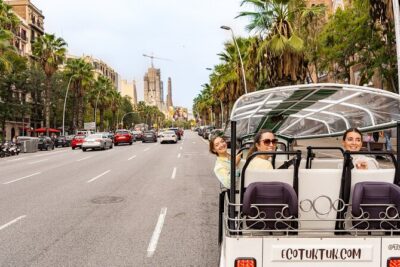
Tour Welcome Barcelona with Local Guide in Eco Tuk Tuk Private
Read our review →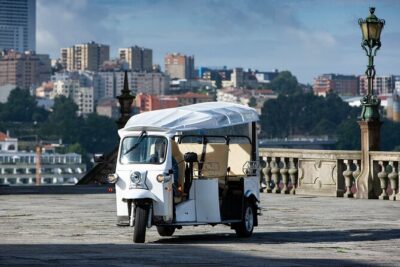
Discover Porto’s Highlights on a 2-Hour Private Electric Tuk Tuk
Read our review →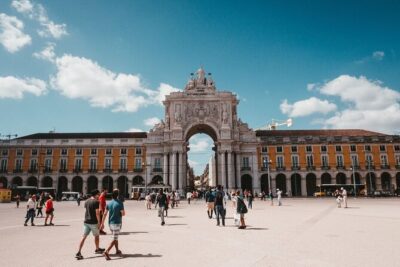
Welcome Lisbon Tour with Local Guide in Private Eco Tuk Tuk
Read our review →