
Review · SPAIN
Madrid Tuk Tuk & Olé Experience – Private 1.5h Cultural Tour
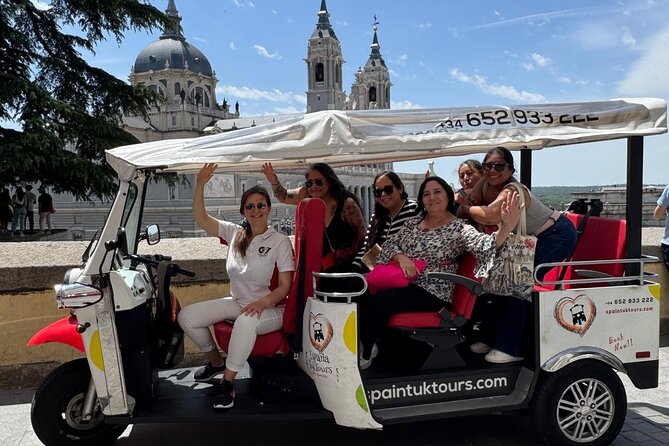
Madrid rewards a quick first look. This private tuk tuk ride links royal buildings, grand boulevards, art museums, and neighborhood landmarks in just 90 minutes. I like the private format, which keeps the outing focused on your group, and I like the efficient route through central Madrid. The main tradeoff is simple: this is a sightseeing sampler, not a museum visit or a slow walking tour.
The price is $167.02 for up to four people, which works out to about $41.76 each for a full group. I also appreciate that guides such as Sebastian, Simon, Pedro, Pablo, and Charly have been praised for clear explanations, local tips, and a good sense of humor. Traffic can slow the ride later in the day, so an early start may help.
Key reasons to consider this Madrid tuk tuk tour
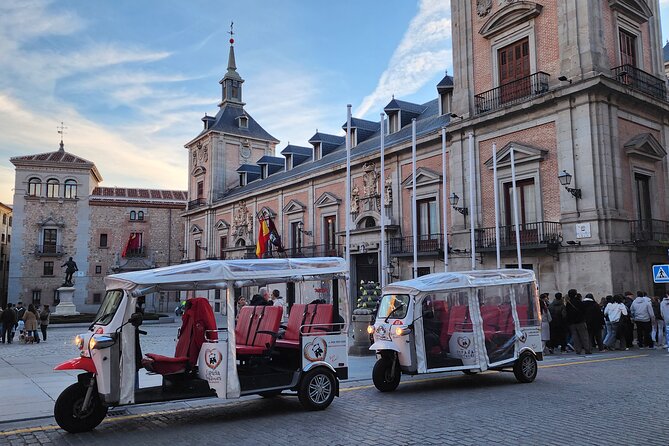
- Ninety minutes cover royal Madrid, the art district, Salamanca, and Gran Vía
- A private vehicle keeps the outing limited to your own group of up to four
- The route includes major sights such as the Royal Palace, Prado, Reina Sofía, and Las Ventas
- Guides add stories, historical context, and neighborhood suggestions
- The tour begins and ends at Plaza de la Lealtad near the Retiro area
- No attraction admissions are included, so the focus stays on outside views and commentary
A fast way to understand Madrid
This tour is built for orientation. From the starting point at Plaza de la Lealtad, near the Retiro district, you move across several parts of central Madrid without spending your limited vacation time figuring out metro connections or walking between far-flung sights.
I see the tuk tuk as especially useful during a first day in the city. You get a broad picture of Madrid’s royal core, cultural institutions, grand avenues, and fashionable Salamanca district. Then you can decide where to return on foot or where to buy an admission ticket later.
The route is packed. Eighteen listed sights in 90 minutes means some places will be brief drive-bys, while others may receive a short pause. You should not expect to enter the Royal Palace, Prado Museum, Reina Sofía, or Las Ventas during this outing. The listed admission cost is free because the experience includes the outside tour and guide service, not museum entry.
That limitation is not a flaw if you understand the purpose. This is a moving introduction to Madrid, with a private guide pointing out what deserves more of your time.
More history rides around Madrid:
- Madrid Historical Tour with Local Guide in Eco Tuk Tuk Private
★ 5.0 · 876 reviews - Tour of Historic and Modern Madrid with a guide in a yellow tuk tuk
★ 5.0 · 71 reviews - Madrid: Tuk-tuk tour of the historic center and highlights
★ 4.7 · 20 reviews
From Plaza de la Lealtad to the Royal Palace
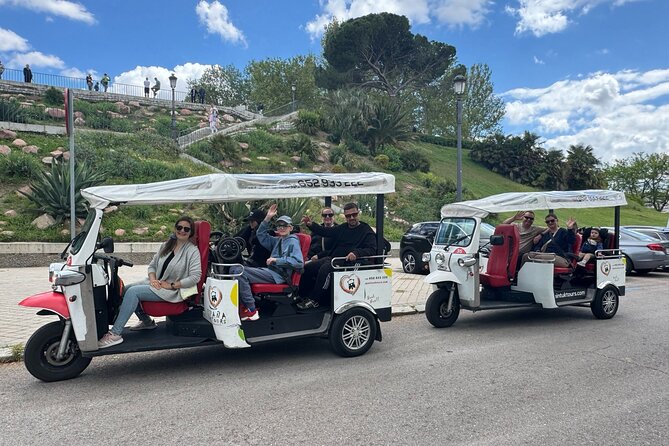
The meeting point is Plaza de la Lealtad, a practical starting place near the Retiro area and Madrid’s museum district. From there, the route heads toward the old city and the Royal Palace of Madrid.
The palace is enormous, with 3,418 rooms and roughly 135,000 square meters of space. It is described as the largest royal palace in Western Europe, and its scale is difficult to appreciate from a single photograph. Your guide can supply the royal context as you view the exterior and surrounding area.
The Palace of the East, as it is also known, remains the official residence of Spain’s king, though royal ceremonies and daily residence are not the same thing. This is a good example of what the tuk tuk format does well: you receive useful background while seeing the building in its urban setting, rather than standing in a ticket line.
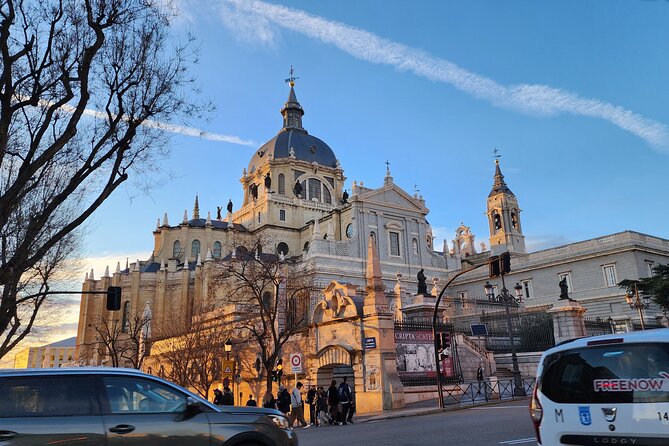
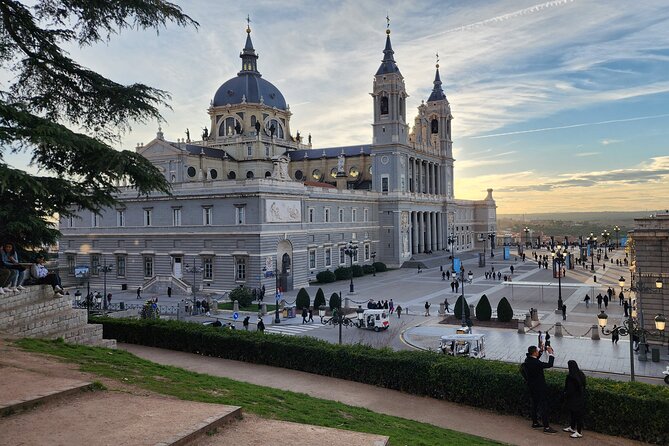
Next comes Almudena Cathedral, Madrid’s principal Catholic cathedral and the seat of the city’s archbishop. Its name comes from the Arabic al-mudayna, meaning citadel, and the cathedral was built on the site of an old mosque.
Almudena is particularly interesting because its exterior and interior reflect different periods and styles. The outside is Neoclassical, the inside is Neo-Gothic, and the crypt is Neo-Romanesque. Construction stretched from the late 19th century into the late 20th century, so you are looking at a building shaped by a long, changing process rather than one single design moment.
San Francisco el Grande and Puerta de Toledo
The Royal Basilica of San Francisco el Grande follows on the historic route. Its large dome and prominent position near the intersection of Calle Bailén and Carrera de San Francisco make it an important architectural marker in western Madrid’s old center.
The basilica is connected with a Franciscan convent founded in the early 13th century. That link gives the stop more weight than a quick exterior photograph might suggest. You are seeing part of Madrid’s religious and urban development, not simply another ornate church.
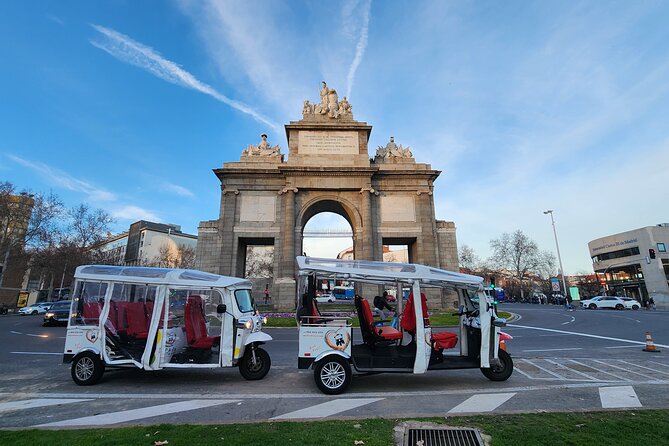
Puerta de Toledo then shifts the story toward the city’s old defenses and entrances. Madrid once had several gates called Toledo. The present gate dates from the first third of the 19th century and was designed by architect Antonio Aguado.
It was built as a triumphal arch honoring Ferdinand VII and commemorating Spanish independence after the French occupation. The location now functions as a roundabout, so a tuk tuk gives you a convenient way to view the monument without trying to cross a difficult traffic circle on foot.
The Neptune Fountain and Atocha Station
At Plaza de Cánovas del Castillo, the route passes the Neptune Fountain. This Neoclassical fountain was proposed in 1777, built between 1782 and 1786, and moved to its current square in 1898.
The fountain is one of Madrid’s famous football landmarks. Atlético Madrid supporters traditionally gather around it, while Real Madrid supporters have their own symbolic fountain elsewhere in the city. That detail may or may not be part of your guide’s commentary, but the location is a useful point for understanding how Madrid’s public monuments serve modern city life as well as older royal design.
Atocha Station offers a sharp change of mood. The railway complex near Plaza del Emperador Carlos V is the country’s busiest station by passenger traffic. It began as a simple stop in 1851 and was expanded into the Midi Station, completed in 1892.
The station is worth seeing even if you are not catching a train. Its history explains how Madrid grew into a national transport center. The tuk tuk lets you view this busy part of the city without committing to a separate station visit.
More private tuk tuk tours around Madrid:
- Madrid: Private City Tour by Eco Tuk Tuk
★ 4.9 · 3,465 reviews - Madrid Welcome Tour with Local Guide in Eco Tuk Tuk Private
★ 5.0 · 2,936 reviews - Madrid Express Tour with Local Guide in Eco Tuk Tuk Private
★ 5.0 · 413 reviews - Madrid: City Tours – 6 seats private ecological tuk tuk
★ 4.6 · 230 reviews
Reina Sofía, Los Jerónimos, and the Buen Retiro remains
The Museo Nacional Centro de Arte Reina Sofía occupies a former general hospital near Atocha. The original 18th-century building was designed by José de Hermosilla and later continued by Francesco Sabatini. A newer building, designed by Jean Nouvel, expanded the museum in 2005.
The museum is best known for 20th-century and contemporary art, including Picasso’s Guernica. The painting is no longer housed at the nearby Casón del Buen Retiro, but the connection between Madrid’s major art institutions is part of the city’s cultural story.
You pass Los Jerónimos, the popular name for the old monastery of San Jerónimo el Real. It was once among Madrid’s most important monasteries and stood beside the Royal Room that later became part of the Buen Retiro Palace complex.
The Casón del Buen Retiro is one of only two surviving buildings from that former palace. Built by Alonso Carbonel in 1637, it originally served as a ballroom for the court of Philip IV. It later housed 19th-century paintings and, for a period, Picasso’s Guernica. Today it functions as a study center connected with the Prado Museum.
The nearby Salón de Reinos was the ceremonial heart of the old Buen Retiro Palace. Its name refers to the coats of arms of the 24 kingdoms that made up the Hispanic Monarchy under Philip IV. It was also known for many years as the Army Museum before that collection moved to Toledo.
These stops are valuable even if you do not enter them. Together, they show how Madrid’s royal spaces were adapted over time into museums, study centers, and public institutions. You get a useful link between palace power, art, and modern city life.
The Prado, Puerta de Alcalá, and Las Ventas
The Prado Museum is the artistic high point of the route. It has especially strong collections of Spanish and European painting from the 15th through the 18th centuries, along with major 19th-century Spanish works.
The museum is closely associated with Velázquez, El Greco, Goya, Titian, Rubens, and Bosch. Goya is the most widely represented artist in the collection. If you have only one art museum on your Madrid schedule, the Prado deserves serious attention, but this tuk tuk outing only gives you an exterior orientation and a reason to return for a proper visit.
Puerta de Alcalá is one of Madrid’s five former royal gates. It now sits in the center of Plaza de la Independencia, beside entrances to Retiro Park. Its position at the meeting point of Alcalá, Alfonso XII, Serrano, and Salustiano Olózaga streets makes it one of the city’s most recognizable urban views.
The stop at Las Ventas introduces another side of Madrid. The bullring is Spain’s largest, with space for 23,798 spectators, and is among the world’s largest arenas. Even if bullfighting is not part of your interests, its size and architecture make it a significant city landmark.
The tour does not include entry to Las Ventas, so treat this as a look at the building and its place in Madrid rather than a full cultural visit. Your guide may help explain its role, but the experience is not designed to settle the larger debate around bullfighting.
Salamanca, the National Library, and Banco de España
The Salamanca district gives the route a more polished, modern character. Developed in part during the 19th century by José de Salamanca y Mayol, Marquis of Salamanca, it is now one of Madrid’s main luxury shopping areas.
The key streets include Serrano, Claudio Coello, and Ortega y Gasset. Even if designer shopping is not on your list, the district helps you see the contrast between the old royal center and Madrid’s more affluent 19th-century expansion.
The National Library of Spain is another worthwhile exterior stop. Founded in 1713 on the initiative of Juan Manuel Fernández Pacheco, it safeguards roughly 30 million publications produced in Spain since the early 18th century, including books, maps, prints, drawings, sheet music, magazines, and pamphlets.
The Bank of Spain brings you back to the financial heart of the city. Founded in Madrid in 1782 under Charles III, the institution now serves as Spain’s central bank and banking supervisor within the European system.
Its main headquarters was built between 1884 and 1891 at the junction of Calle Alcalá and Paseo del Prado, facing Plaza de Cibeles. This is an especially good example of Madrid’s grand civic architecture, where government, finance, art, and public space meet within a few blocks.
Gran Vía finishes the ride
Gran Vía is a fitting final stop because it brings together shopping, theater, architecture, and city energy. The avenue runs from Calle de Alcalá to Plaza de España and became one of Madrid’s main commercial and entertainment streets after its construction in the early 20th century.
The section between Plaza de Callao and Plaza de España is often called Madrid’s Broadway because of its musical theaters. Other sections are lined with international fashion chains, cinemas, and large commercial buildings.
A final look at Gran Vía gives you an easy plan for the rest of your day. You can return for shopping, an evening theater performance, or a walk toward Plaza de España. One useful feature of the outing is that it ends back at the original meeting point, so you are not left figuring out a distant drop-off.
Guides, timing, and the private format
The strongest part of this experience is the guide. Sebastian has been praised for explaining Madrid’s monuments in detail, while Simon received specific praise for a strong route and a memorable final view. Pedro was singled out for making a family visit more historical, and Pablo was described as accommodating and informative.
Charly’s style combines historical information, anecdotes, and humor. One guide also spoke Italian throughout a private outing to make the history easier to follow. The advertised language for this tour is English, so you should treat other languages as guide-dependent rather than guaranteed.
Timing matters. The route covers busy central roads, and Simon’s advice was practical: start early if you can, since traffic may slow the tuk tuk later in the day. The private setup also helps because the guide can focus on your group of up to four rather than managing a large party.
At $167.02 per group, the value is strongest with four people. A full group pays about $41.76 per person for 90 minutes of private transportation and commentary. For one person, the same price feels much less attractive, unless convenience and a private guide matter more to you than cost.
Confirmation is provided when you book. Service animals are allowed, public transportation is nearby, and most people can participate. You can cancel for a full refund up to 24 hours before the start time. Changes or cancellations made inside that window are not refunded.
Who should book this Madrid tuk tuk tour?
I would choose this tour for a first visit, a short stay, or a family group that wants to see many landmarks without a long walk. It also suits anyone arriving in Madrid with no clear sense of how the palace, museum district, Salamanca, and Gran Vía fit together.
You should be comfortable with a fast pace and outside viewing. If your priority is entering museums, studying paintings, or spending quiet time inside churches, book separate admissions and use this ride as an orientation.
The tour is also a good choice for a group of four. Sharing the fixed price makes the numbers work, and the private format lets you ask questions about the sights that interest you most. An early departure is sensible if your schedule allows it.
Should you book it?
Book the Madrid Tuk Tuk and Olé Experience if you want a compact, private introduction to the city with a guide who adds stories rather than simply pointing out buildings. The route is broad, the vehicle saves walking time, and the strongest guide feedback centers on clear explanations, kindness, humor, and useful local suggestions.
Skip it if you want a slow, detailed visit inside Madrid’s museums and monuments. For most first-time visitors with 90 minutes to spare, I see it as a practical starting point: take the ride early, note the places you want to revisit, then return on foot for the full experience.
FAQ
How long is the Madrid tuk tuk tour?
The tour lasts approximately 1 hour and 30 minutes.
How many people can join the private tour?
The private booking is for up to four people, and only your group participates.
What language is offered?
The tour is offered in English. A guide has also spoken Italian during a past outing, but additional languages are not listed as guaranteed.
Where does the tour begin and end?
It starts at Plaza de la Lealtad, 1, in the Retiro area of Madrid, and ends back at the same meeting point.
Are entrance tickets included?
No attraction admission is included. The listed stops have no admission charge as part of this tour, which focuses on sightseeing and guide commentary.
Can I cancel for a refund?
Yes. You can cancel at least 24 hours before the start time for a full refund. Cancellations or changes made less than 24 hours before the start time are not refunded.
Just added around Madrid
- Tuk Tuk Tour with Wine Test in Madrid★ 3.8 · 6 reviews
- Tuktuk historical tour of Madrid 1 Hr in a fun and original way★ 4.1 · 4 reviews
- Tuk-tuk Tour: Private tour of downtown Madrid★ 4.0 · 2 reviews
- Tuk-tuk tour of downtown Madrid★ 5.0 · 2 reviews
- Discover Madrid in a Fun & Eco-Friendly Tuk-Tuk – Private Tour★ 4.0 · 4 reviews
- Eco Friendly Tuk Tuk Experience with the Local in Madrid★ 5.0 · 4 reviews
- Tour of Castizo Madrid with a private guide in a yellow Tuk-Tuk★ 5.0 · 26 reviews
- Tuk Tuk Tour of the Best of Madrid (booking only)★ 5.0 · 2 reviews
Historical Tours, compared.
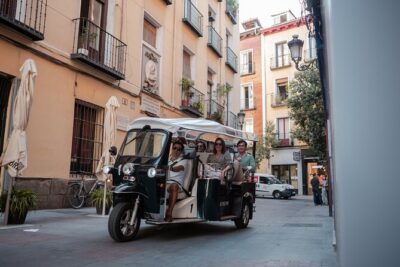
Madrid Historical Tour with Local Guide in Eco Tuk Tuk Private
Read our review →
Explore Lisbon by Tuk Tuk: History and Viewpoints
Read our review →
Historic Porto by Private Electric Tuk Tuk to Top Landmarks
Read our review →
Private Tuk Tuk Tour Through Lisbon’s Historical Streets
Read our review →
Guided Tuk-Tuk Tour Along the Historic Tram Line 28
Read our review →
Porto Guided Tour to the Historical Center on a Tuk Tuk
Read our review →
Historic Lisbon Tour with Local Guide in Private Eco Tuk Tuk
Read our review →Browse the lists this tour appears in