
Review · ITALY
Olbia : Tuk-Tuk Tour – Ancient Treasures of Sardinia + pickup
History rides shotgun in Olbia. This private tuk-tuk tour packs Sardinia’s ancient sites into two and a half hours, with a driver, audio system, and several stops that are hard to reach without a car. I especially like the varied route, which moves from a Roman aqueduct to a Nuragic sacred well, and the small private format, which keeps the outing easy to manage. The main concern is value: at $180.21 per person, it is expensive unless you are traveling as a small group and need transport.
You will cover a lot of ground, including San Simplicio Basilica, the Sacred Well of Sa Testa, the Roman aqueduct, the Giants’ Tomb, and Pedres Castle. The audio commentary can help, but the quality of the live guiding may depend on your driver, so this suits visitors who want a practical overview more than a full archaeological lecture.
Key points at a glance
- The Sacred Well of Sa Testa gives you a close look at Nuragic water rituals and one of Gallura’s most unusual ancient monuments.
- Pedres Castle adds a hilltop view and medieval history to a route otherwise focused on prehistoric and Roman sites.
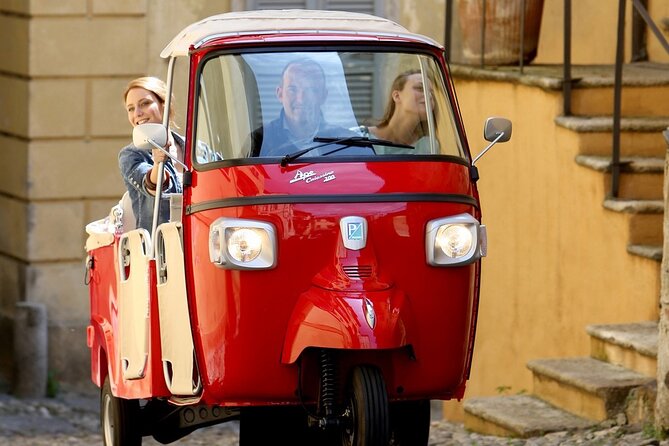
- A tuk-tuk solves the transport problem, especially for cruise passengers without a rental car.
- The tour is private, so only your own group rides together.
- The audio system matters, since some drivers may rely heavily on prerecorded explanations rather than continuous live commentary.
- Bring water and a church-appropriate cardigan, since neither bottled water nor church cover-ups are included.
What this Olbia tuk-tuk tour is really designed to do
This is a compact sightseeing circuit, not a slow museum visit. In roughly 150 minutes, you ride between several important places around Olbia and its outskirts, stepping out for short visits along the way.
That makes the tour useful when your time is tight. Cruise passengers can see much more than the port area, and visitors without a car can reach sites that are not especially convenient by public transport. The tuk-tuk also gives the outing a lighter, more open-air feel than a standard minibus.
The route is private, which is a real benefit. You do not need to wait for a large group, and your party can stay together from pickup through the return to the starting point. The tradeoff is cost. At $180.21 per person, the price is easier to justify for two or more people sharing a private vehicle than for a solo visitor.
The tour is offered in English and includes a clear audio system with speakers. That sounds simple, but it matters when the vehicle is moving and the surrounding traffic makes normal conversation difficult. At the same time, you should know what you are buying: the experience may feel closer to a narrated driving tour than to a traditional guide-led archaeology walk.
A few more tuk tuk tours around Italy worth a look
- Florence Private Transportation in Rickshaw
★ 5.0 · 730 reviews - Florence: Private Transport by Rickshaw
★ 5.0 · 659 reviews - Sorrento Farm by Tuk Tuk: Cheese, Limoncello & Hands-On Pizza
★ 5.0 · 628 reviews
San Simplicio Basilica and Olbia’s underground past
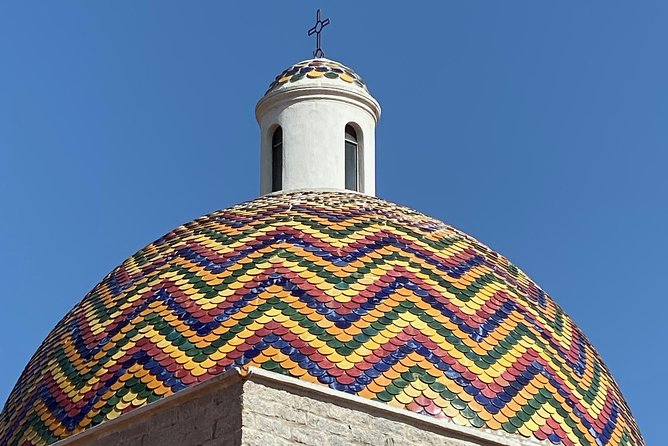
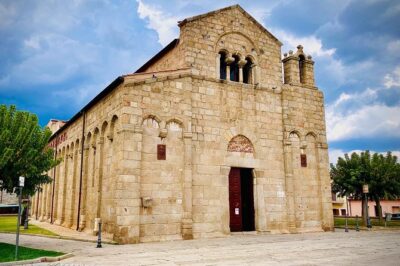
The first stop is the Basilica of San Simplicio, the oldest and most important religious monument in northeastern Sardinia. The church is dedicated to Saint Simplicio, described as Olbia’s first bishop and a martyr under Emperor Diocletian.
San Simplicio served as the city’s cathedral until 1839 and became a minor basilica in 1993 under Pope John Paul II. Those details give the building real historical weight, but the visit itself is brief, at about 10 minutes.
There is also a necropolis beneath the basilica. That adds an important layer to the stop, since the site is not only a functioning church but also a place connected with earlier burial practices. If you enjoy seeing how one location changes over time, this is a strong opening to the tour.
Admission to the basilica is not included. You may also need a cardigan or other covering to enter a church, and the tour specifically notes that this is not provided. In warm weather, keep a light cover handy rather than assuming your regular sightseeing clothes will be acceptable.
The short visit means you should not expect a detailed interior study. You are getting orientation and a quick look, not a long church tour.
Sa Testa Sacred Well and Nuragic Sardinia
The Sacred Well of Sa Testa is one of the most distinctive stops on the route. It comes from the Nuragic civilization, which shaped much of Sardinia long before the Roman period.
The site was used for water rituals. Its design makes the purpose easier to understand than a bare foundation or scattered stones would. You can see why water held such importance in a dry island environment, and the monument gives you a direct connection to religious life in prehistoric Sardinia.
You have about 15 minutes here, with admission included. That keeps the visit efficient, though it also limits the time available for close inspection or extended questions. I would pay attention to the stonework and the way the well was designed around access to water, rather than treating it as a quick photo stop.
This is one of the places where the tour earns its archaeological focus. It is not simply a pretty stop. It introduces an ancient culture that can be difficult to understand from a city center alone.
The Roman aqueduct and its stone water tanks
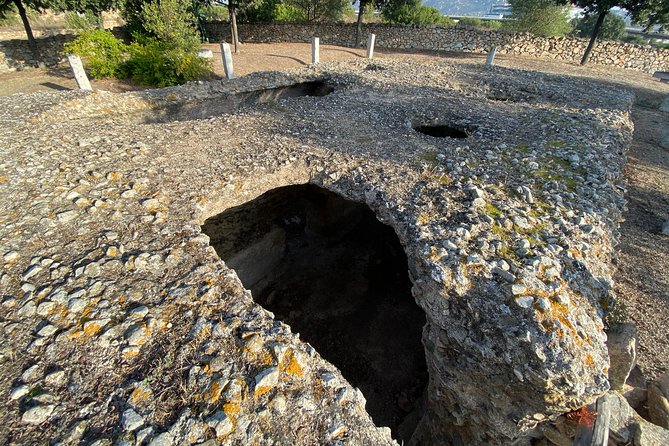
The Roman aqueduct of Olbia dates from the first or second century AD. It collected water from springs on Mount Cabu Abas and carried it toward the ancient city.
The surviving remains include arches and water channels, along with a large settling tank cut directly into the rock. The tank has six ventilation openings, and two smaller tanks sit beside it. There is also an inlet and outlet well.
The site is described as the best-preserved Roman archaeological site in Sardinia. That is a strong reason to take the stop seriously, even though the visit lasts only 15 minutes.
The aqueduct also helps connect the earlier Nuragic stop with Olbia’s Roman period. You can see how the island’s communities moved from sacred water sources to a more engineered system designed to serve an urban population.
Admission is included. Since the visit is short, you will want to listen carefully as the audio explanation begins. One critical point from the available feedback is that the recorded narration may not always start at the perfect moment. If you want more context, ask your driver to clarify the parts that interest you instead of relying only on the speaker system.
Same place, a completely different ride:
- Bari: Old Town Guided Eco-Friendly Rickshaw Tour
★ 4.9 · 355 reviews - Private Tour of the Medieval Village of Ostuni by Tuk Tuk
★ 4.5 · 278 reviews - Private Florence Tour by Golf Cart ETukTuk with Audio Guide
★ 4.0 · 256 reviews - Lecce: City Highlights Guided Tour by Rickshaw
★ 4.8 · 236 reviews
The Giants’ Tomb at Su Monte ’e S’Abe
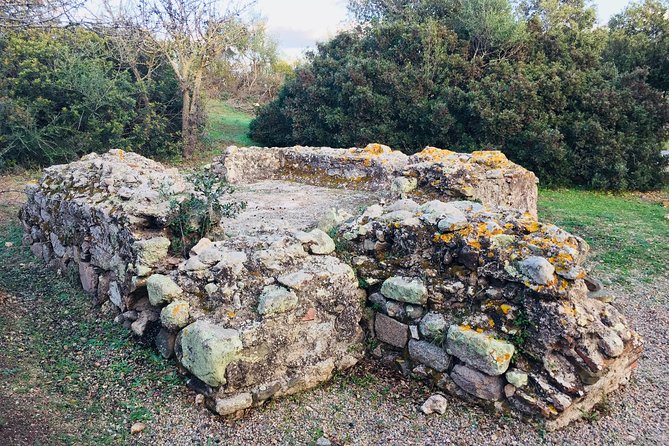
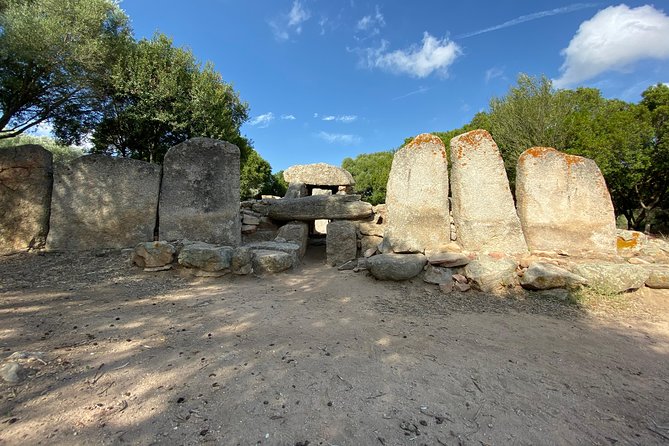
The Tomba dei Giganti Su Monte ’e S’Abe dates back more than 4,000 years. Its shape is linked with the head of a bull, an important Nuragic religious symbol.
The name Giants’ Tomb can sound dramatic, but it does not mean that actual giants were buried there. These were communal prehistoric burial monuments, and their scale and layout reflect the beliefs of the society that built them.
You spend about 10 minutes at the site, with admission included. That is enough to see the basic structure and understand why it matters, but not enough for a long walk or a detailed discussion of every stone.
I like this stop because it makes prehistoric Sardinia feel less abstract. After seeing the Sacred Well, you encounter another Nuragic monument tied to ritual and belief. The two sites work better together than either would alone.
Expect limited shade and strong sun in summer. The tour does not include bottled water, so bring your own bottle, especially if you are visiting during a hot afternoon. One unhappy experience reported a temperature of 35 degrees Celsius and no water supplied. The practical lesson is simple: the lack of included water is clearly stated, so prepare for the conditions yourself.
Pedres Castle and the best short view
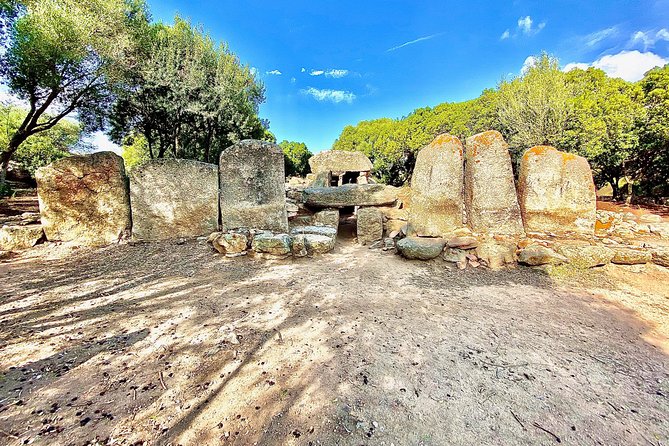
The final major stop is Castello di Pedres, a medieval fortress on an 89-meter hill above the southern part of the Olbian basin.
The castle dates from the late 13th or early 14th century, during the period of Pisan and Aragonese control and the rise of the Visconti family. That shifts the tour into a later chapter of Sardinian history, after the Nuragic and Roman periods.
You have about 25 minutes here, the longest stop on the main route. That gives you more time to take in the ruins and the hilltop setting. The castle is especially useful for visitors who want more than ancient archaeology, since it adds medieval politics, military history, and a change of scenery.
The climb and uneven ground may require sensible footwear. The supplied information does not promise a fully accessible route, so anyone with mobility concerns should confirm details before booking. Do not assume that a vehicle tour removes all walking.
Olbia’s city stops fill out the picture
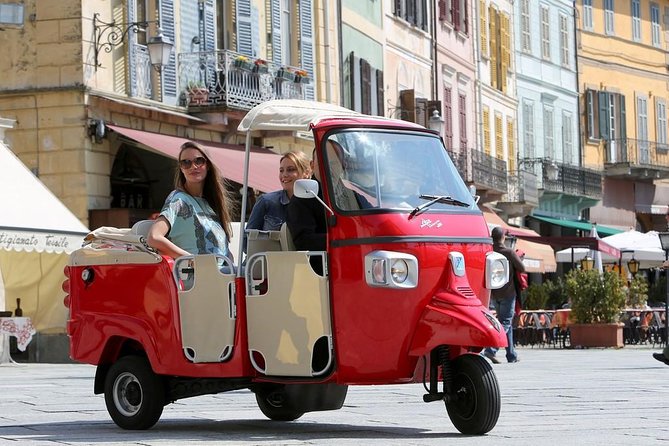
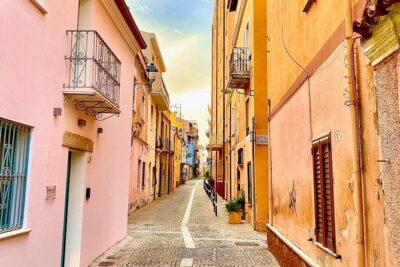
The route also passes or includes several city sights: Olbia’s main historic street, Fausto Noce Park, the Archaeological Museum, and the area below San Simplicio Basilica.
Fausto Noce Park is Olbia’s green center, covering 18 hectares. In 2005, it was recognized as Italy’s second-best green project. The park is not an archaeological site, but it gives you a quick sense of daily Olbia beyond its ancient stones.
The Archaeological Museum is another useful reference point, though the tour details do not promise a museum admission or a long interior visit. If you want a serious look at artifacts, allow separate time for the museum rather than expecting the tuk-tuk circuit to replace it.
The main historic street helps connect the sites to the modern town. That is worthwhile because Olbia can otherwise feel like a collection of stops seen from a vehicle. Still, some people may find the park and city street less exciting than the Sacred Well, aqueduct, tomb, and castle.
This explains the mixed reactions to the route. If you expect every stop to be a ruin, the church, park, and city center may feel like padding. If you want a quick introduction to Olbia as a living city with several historical layers, they make more sense.
Live guide or recorded commentary?
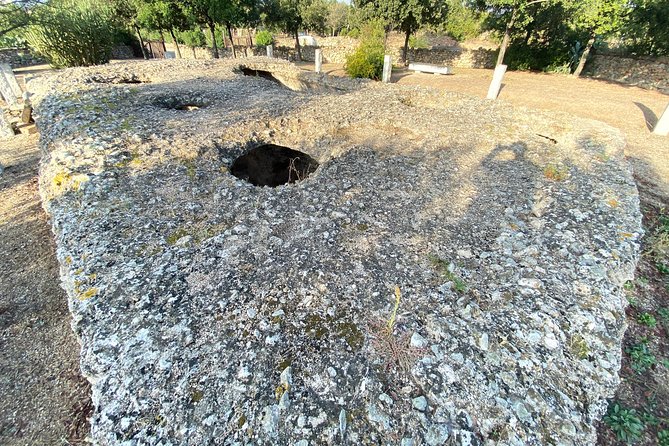
The tour includes a professional driver and an audio system with speakers. Some experiences on this route have included a driver who explained the sites directly, while other accounts describe a mostly quiet driver with prerecorded audio clips.
That difference is important. The tour is advertised in English, but an English-speaking driver does not necessarily mean you will receive a continuous, detailed lecture while the vehicle is moving. You may get short recorded sections at each location, followed by brief interaction at the stop.
I would treat the audio as a useful framework, not a substitute for a specialist guide. Ask questions when the vehicle is parked, particularly at the aqueduct and the Nuragic monuments. If you want a tour built around long explanations and academic detail, this may feel too light.
On the other hand, the format has clear advantages. You avoid reading every sign yourself, and the audio can give you the basic dates, purpose, and historical setting before you step out. One German-language account praised the friendly guide, clear explanations, and audio information, so the personal element can be good when the assigned driver engages with the group.
Pickup, cruise timing, and practical details
The regular meeting point is Smeralda 360 at Molo Brin 1 in Olbia. The tour ends back at that meeting point.
Cruise passengers should take the free shuttle from beneath the ship to the Maritime Station. From there, exit through the main entrance, where a Smeralda 360 representative should be waiting with a sign. Arrive at least 10 minutes early.
City-center pickup and drop-off are free. Hotel or apartment pickup is available for an extra charge, with collection at the main entrance. The vehicle is marked with Smeralda 360 writing, and the driver can wait only a few minutes, so be ready outside at the agreed time.
This setup can work well for a port day, but do not confuse pickup availability with protection from cruise schedule problems. If your ship skips Olbia or changes ports, the operator says refund conditions follow the booking terms. Check the cancellation rules before paying. Free cancellation is available up to 24 hours before the start time, but late cancellations and late changes are not accepted.
The tour also depends on suitable weather and a minimum number of participants. If the operator cancels for either reason, you should be offered another date, another experience, or a full refund.
Is $180.21 per person fair?
The price is high for a two-and-a-half-hour outing. You are paying for a private vehicle, a driver, included admission at several archaeological sites, and transport between places that are awkward to connect without a car.
The value improves if you are a small group splitting the cost and have only a few hours in Olbia. A rental car could cost less per person, but it would require driving, parking, navigation, and arranging your own route. A taxi between every stop could also become costly and inconvenient.
The value drops if you mainly want the historic center or prefer long visits at individual monuments. The short stop lengths limit reflection, photography, and questions. You are buying access and coverage, not a leisurely archaeological day.
Who should book this tour?
I would recommend it to cruise passengers, first-time visitors with limited time, and small private groups that want to see Olbia’s outlying monuments without renting a car.
It is also a good fit if you enjoy moving between several periods of history: prehistoric Nuragic culture, Roman engineering, early Christian Sardinia, and medieval fortification.
I would hesitate if you want a specialist archaeologist, extensive museum time, guaranteed live commentary, or a low-cost activity. I would also think twice before booking a hot midday departure unless you bring water, sun protection, and practical clothing.
Final decision
Book this Olbia tuk-tuk tour if your priority is efficient sightseeing and easy transport. The Sacred Well, Roman aqueduct, Giants’ Tomb, and Pedres Castle give you a worthwhile look at Sardinia beyond the port, and the private format keeps the schedule simple.
Skip it if $180.21 feels steep for short visits or if you need detailed, continuous guiding. Before booking, confirm your pickup point, check the cancellation terms, and ask how the English commentary will be delivered. Those three checks will tell you if this is a convenient archaeological sampler or an expensive ride between brief stops.
FAQ
How long does the Olbia tuk-tuk tour last?
The tour lasts approximately 2 hours and 30 minutes.
Is the tour private?
Yes. Only your group participates in the activity.
Is pickup included?
Free pickup and drop-off are offered from the city center. Hotel or apartment pickup is available for an additional charge.
Where do cruise passengers meet the tour?
Cruise passengers should take the free shuttle from the ship to Olbia’s Maritime Station, exit through the main entrance, and look for a Smeralda 360 representative.
What language is the tour offered in?
The tour is offered in English and includes an audio system with speakers.
Is bottled water included?
No. Bottled water is not included, so you should bring your own.
Is admission included at every stop?
Admission is included at the Sacred Well of Sa Testa, the Roman aqueduct, the Giants’ Tomb, and Pedres Castle. Admission to San Simplicio Basilica is not included.
What is the cancellation policy?
You can cancel for a full refund up to 24 hours before the scheduled start time. Cancellations or changes made less than 24 hours in advance are not accepted for a refund.
Just added around Italy
- Tuk Tuk Coastal Tour★ 5.0 · 10 reviews
- Syracuse and Ortygia and Park Neapolis Tuk-Tuk Tour★ 5.0 · 5 reviews
- Private Tuk Tuk Tour of the Millenary Olive Groves in Ostuni★ 5.0 · 4 reviews
- Siena E-Tuk Tuk panoramic Aperitivo with Local Snacks★ 5.0 · 2 reviews
- 2 Hours Calessino/ Tuk tuk Tour to Syracuse and Ortigia Island★ 4.5 · 34 reviews
- Ortigia APE-TUK TUK 1-hour private tour★ 5.0 · 22 reviews
- From San Gimignano: Tuscany Wine tour by Tuk Tuk with Lunch★ 5.0 · 13 reviews
- Tour of Vietri and its villages on board the Ape Calessino (tuktuk)★ 5.0 · 9 reviews
Olbia Tuk Tuk Tours, compared.
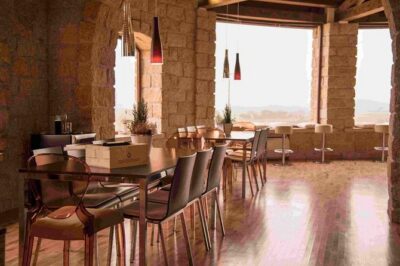
Exclusive Private Tuk-Tuk Tour: Visit to a Sardinian Winery
Read our review →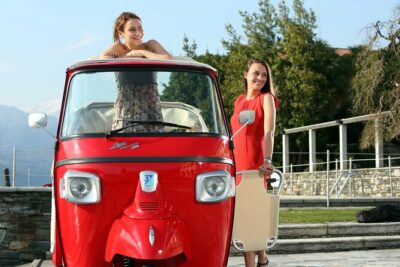
Private tuk-tuk tour with a stop at Pittulongu Beach
Read our review →
Exclusive Private Tuk-Tuk Tour with Pittulongu Beach Stop
Read our review →Browse the lists this tour appears in