Review · THAILAND
Bangkok Electric Tuk Tuk: Thonburi, Wang Lang & Food Tour
Bangkok has more than golden temples. This half-day ride takes you into Thonburi’s backstreets by quiet electric tuk-tuk, then links local food, pottery, a historic railway station, a river crossing, and Thailand’s largest flower market. I like the small maximum of nine people and the chance to meet the Baan Bu pottery community. I also like that the food stops are part of the experience, not an afterthought. The main drawback is value: at $65.03 per person, you are paying for guiding and convenience rather than a long list of major monuments.
The 2 p.m. departure makes sense in a hot city, and the route finishes at Pak Khlong Talat, where you can continue by boat or MRT. Guides such as Pam, Pat, Bo, and Pe-Pae have earned especially warm praise for their care, clear explanations, and ability to adjust the pace. Still, some stops are brief, and the Grand Palace, Wat Pho, and other headline sights are viewed from outside rather than visited.
Five things to know before you book
- Electric tuk-tuk travel: About two hours of the four-hour outing are spent riding through Bangkok in a quieter, all-electric vehicle.
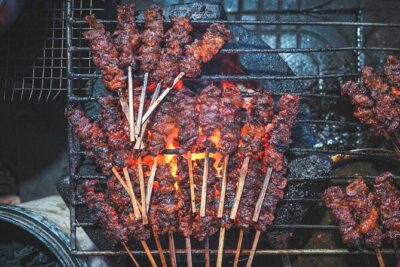
- Local food at Wang Lang: Your included tasting can cover fried pork with sticky rice, Thai desserts, and kanom bueng, with portions intended to add up to a full meal.
- Baan Bu pottery: You visit a six-generation craft community where stoneware has been made for roughly 200 years.
- A real public-transport finish: The route includes the Chao Phraya Express Boat from Pran Nok Pier to Saphan Phut Pier.
- Small-group guidance: The group is capped at nine people, giving you a better chance to ask questions and keep the outing personal.
Why Thonburi is the right side of Bangkok to explore
Many first visits to Bangkok stay east of the Chao Phraya River, near the Grand Palace, Wat Pho, and the main shopping districts. This tour spends much of its time in Thonburi, on the river’s western bank, where the pace feels more local and the streets are less arranged for sightseeing.
You are not simply driven from one famous building to another. The electric tuk-tuk slips into smaller roads and connects places that would be awkward to combine on foot. That matters in Bangkok, where heat, traffic, and confusing distances can turn a short map route into a tiring half-day.
The vehicle is a practical part of the tour, not just a colorful photo opportunity. It is quieter than a standard tuk-tuk and produces no tailpipe emissions while operating. The company describes the route as an effort to reduce the environmental effect of vehicle-based sightseeing, a useful feature if you want to see the city without adding to its exhaust.
You should still expect some walking. The total is about 1.5 kilometers, including market sections, the community visit, and the walk to the pier. Wear shoes that can handle uneven pavement and bring water, even with a later start.
More Tuk Tuk Food Tours in Bangkok
- Bangkok: Midnight Food Tour by Tuk-Tuk
★ 4.9 · 2,054 reviews - Bangkok: Michelin Guide Street Food Tour by Tuk Tuk
★ 4.4 · 1,274 reviews - Bangkok Tuk-Tuk Tour by Night with Chinatown Street Food Meal
★ 5.0 · 635 reviews
Sanam Chai starts the afternoon at 2 p.m.
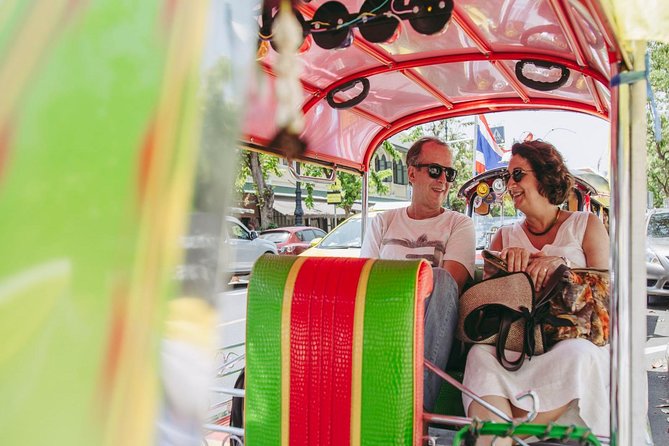
The meeting point is at Sanam Chai, near the old city and the Chao Phraya River. You meet the English-speaking guide and the rest of the small group before boarding the electric tuk-tuk. The start is listed for 2 p.m., so build in extra time to reach Sanam Chai, particularly if you are coming from another part of Bangkok.
Hotel pickup and drop-off are not included. This is a real logistical detail, not a minor footnote. You need to arrange your own way to the meeting point and from Pak Khlong Talat at the end. The finish is well placed for onward travel, since you can use the Chao Phraya Express Boat or MRT Sanam Chai, but the tour does not return you to your hotel.
A strong guide makes the first few minutes useful. Pam, Pat, Bo, and Pe-Pae are all praised for being friendly, attentive, and clear. One particularly useful quality reported by several people is patience when plans become awkward, including waiting for late arrivals and adjusting the pace to suit the group. That kind of help can matter more than a rehearsed speech.
Thonburi reveals Bangkok beyond the postcard route
The first major section lasts about 50 minutes. You pass several temples, including Wat Arun, the Temple of Dawn, while your guide explains the religious and cultural background of the district.
The tour does not include admission to Wat Arun or a full temple visit. That keeps the route moving, but it also means you should not book this as your main temple tour. The benefit is breadth: you see how the temples relate to the surrounding neighborhoods instead of spending the whole afternoon inside one complex.
The electric tuk-tuk is especially useful here. You can watch ordinary streets pass by without the roar and fumes associated with a traditional vehicle. The ride gives you a sense of how shrines, homes, workshops, markets, and traffic fit together in the older part of the city.
This section is also where your guide’s quality matters most. The streets themselves may not explain why a place is important. A good guide gives you the context, points out details you would miss, and answers questions without turning every stop into a lecture. The strongest feedback about this tour consistently focuses on guides who combine information with warmth and humor.
Baan Bu connects pottery with working community life
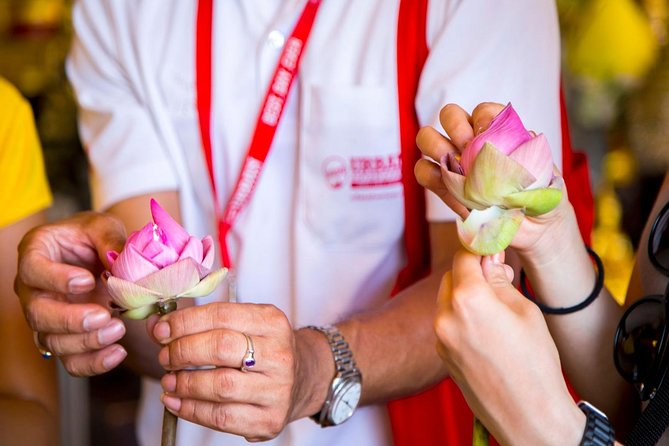
The visit to Baan Bu is one of the tour’s most distinctive features. This traditional community has made stoneware products for six generations, or roughly 200 years. You see a pottery demonstration and learn how a craft can remain tied to a local neighborhood rather than being presented only as a museum display.
That distinction gives the stop its value. You are not just looking at an old technique behind glass. You are being introduced to a living community and to independent people who still make and sell goods. The visit also gives your guide a chance to explain the connection between Bangkok’s past and its present.
Expect a short visit rather than a full workshop. The information provided promises a demonstration, not a hands-on pottery class or a shopping session. If traditional crafts are high on your list, this may be the most rewarding part of the route. If you prefer major monuments, you may find the stop less immediately impressive, but it offers something the standard city circuit often misses.
More Tuk Tuk Food Tours in Thailand
- Bangkok Tuk-Tuk by Night with Chinatown Street Food Meal
★ 4.6 · 263 reviews - Bangkok Tuk Tuk Food Tour By Night
★ 5.0 · 198 reviews - Bangkok Evening Street Food Tuk Tuk Adventure
★ 5.0 · 158 reviews - Bangkok Adventure Tuk Tuk Food Tour
★ 4.6 · 97 reviews
Thonburi Railway Station adds a piece of transport history
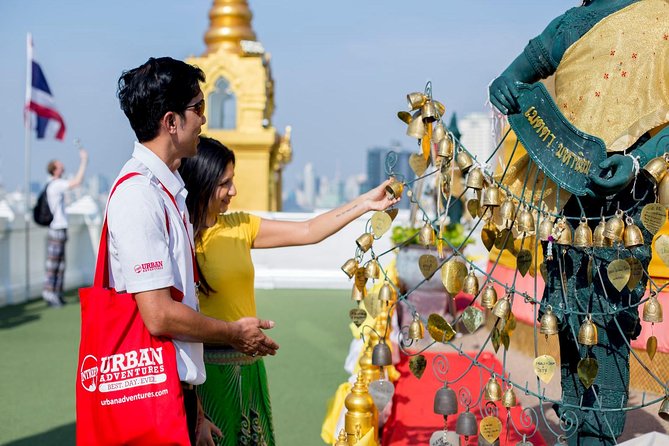
The tuk-tuk then heads to Thonburi Train Station. The station opened in 1906, and some historic steam locomotives are still kept there. The scheduled stop is about 15 minutes, so think of it as a compact introduction rather than a museum visit.
The station gives the route a useful change of subject. After temples and pottery, you get a look at engineering and the role of rail travel in Bangkok’s development. Your guide explains the significance of the locomotives, which helps you see them as more than old machinery.
The short timing is both a strength and a limitation. You can appreciate the setting without losing a large part of the afternoon, but rail enthusiasts may want more time. There is no promise of an extended railway tour or access to every locomotive, so keep your expectations modest.
Wang Lang Market is the food center of the tour
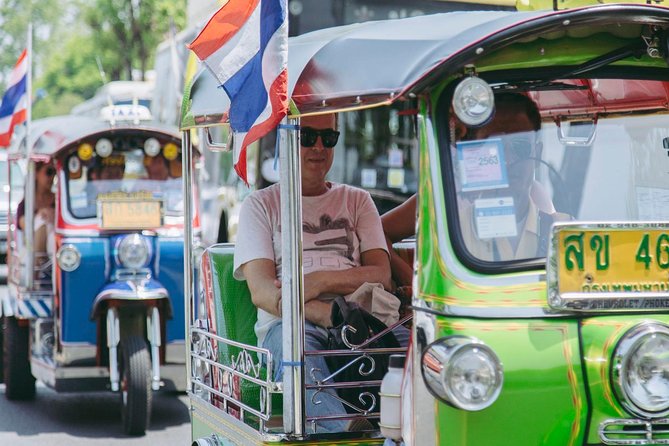
Wang Lang Market receives about an hour, making it the longest stop. This is where the tour shifts from looking at Bangkok to tasting it.
The included food can include fried pork with sticky rice, Thai desserts, and kanom bueng, a crisp Thai snack often filled with sweet or savory ingredients. The exact choices and portion sizes change with the season and with the vendors available that day. The organizers state that the total food should equal a full meal, so you should arrive ready to sample rather than expecting one fixed restaurant dish.
This is a good reason to use a guide. Market food can be hard to choose when you do not know what is fresh, what is typical, or how much to order. Your guide can help you sample several things without wasting money on a plate you do not enjoy.
The market also gives you views across the Chao Phraya toward the Grand Palace. This is a different experience from standing in the palace grounds. You see the river as a working public space and the major landmark from another district, with food stalls and daily commerce around you.
Vegetarian food can be accommodated, but other dietary requirements are not listed as available. Tell the operator about vegetarian needs when booking, and do not assume that allergies or other restrictions can be handled. Extra food and drinks are not included.
Not every market section will appeal equally. Some people find parts of the surrounding Indian market or clothing areas less interesting than the food market itself. The flower market later in the route is generally the stronger market stop if you want color, movement, and a clear sense of trade.
A riverside café gives the afternoon room to breathe
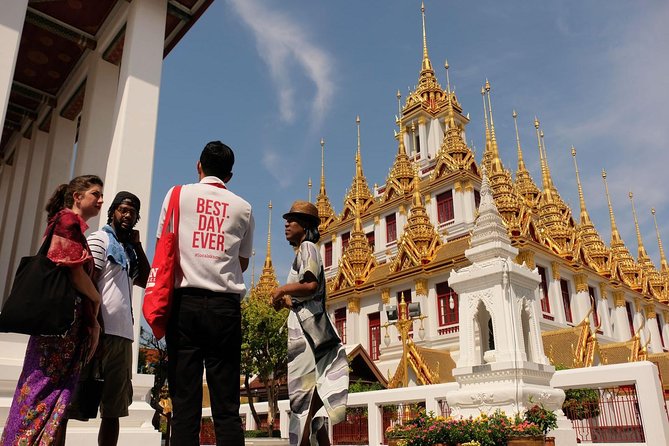
After Wang Lang, you walk to Pran Nok Pier and stop at a riverside café. Coffee or tea is included, while other drinks are extra. The point is less about the beverage than the pause.
Bangkok sightseeing can become a blur of roads, temples, and packed lanes. A seated break by the river lets you slow down and take in views toward the Grand Palace. It also gives you a chance to ask your guide questions and decide which parts of Bangkok you want to return to on your own.
The café stop is not a luxury add-on. It helps the four-hour route feel manageable, especially in warm weather. Still, it is a simple refreshment stop rather than a meal or a long scenic cruise.
The express boat turns transportation into sightseeing
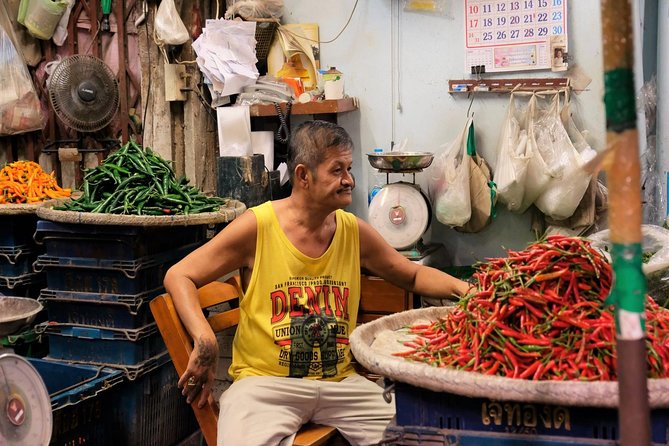
From Pran Nok Pier, you board the Chao Phraya Express Boat to Saphan Phut Pier. The ticket is included, and the boat ride takes about 20 minutes, including the walk and transfer portion of the itinerary.
This is one of the tour’s smartest choices. You get to use a normal form of Bangkok transport while moving efficiently to the final stop. The river also offers a fresh view of the city, with temples, bridges, river traffic, and old neighborhoods appearing from the water.
Do not expect a private boat or a guided river cruise. This is public transport, and that is precisely the appeal. You are using the same kind of service that residents rely on, with your guide handling the basic route.
Pak Khlong Talat finishes with flowers and late-day energy
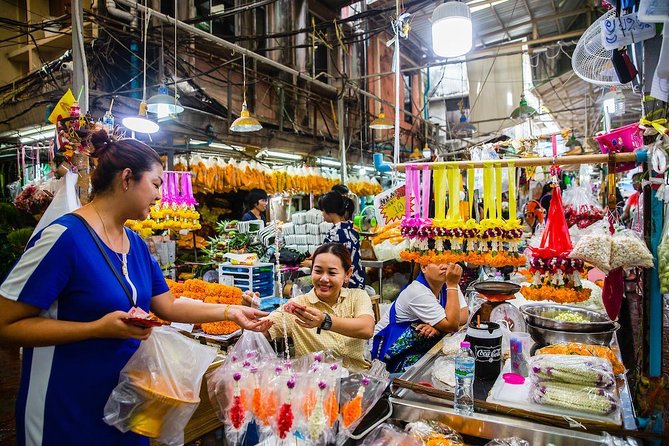
The final stop is Pak Khlong Talat, Bangkok’s largest flower market. It operates around the clock, seven days a week, and distributes flowers to other cities across Thailand.
You have about 30 minutes here. That is enough to see the market’s main activity, smell the flowers, and watch bouquets and loose blooms move through a major distribution point. It is also a practical place to end, since the market is close to the river and MRT Sanam Chai.
Give this stop your attention. One complaint about similar routes is that a guide can walk too quickly past the best part of the market. Stay alert and ask to pause if you want time for photographs or a closer look. The flower market is not merely decorative. It shows how Bangkok’s trade networks work, from growers and suppliers to vendors and buyers.
The outing ends here, not back at Sanam Chai. That is convenient if you want to continue exploring the old city, but less convenient if you have evening plans elsewhere. Check your onward route before you leave.
What the $65.03 price really buys you
At $65.03 per person, this is not the cheapest way to cover the same general area. You could use public transport, walk through markets, and arrange food on your own for less.
The price becomes easier to justify if you value the combination. You get an electric tuk-tuk for much of the route, a local English-speaking guide, market tastings equal to roughly a full meal, a pottery demonstration, a riverside café drink, and the express boat ticket. You also avoid working out the order of several stops in a city where traffic and heat can eat up time.
The small-group limit of nine is important. A large coach would make the markets and community visit clumsy. A small group gives you more room to ask questions, and guides such as Pam and Pat have been singled out for making people feel looked after.
I would call the tour good value for a first or second Bangkok visit, especially if you want orientation and local context. I would call it less convincing if you are already comfortable navigating Bangkok or want entrance time at the Grand Palace, Wat Pho, or Wat Arun.
You can cancel for a full refund up to 24 hours before the 2 p.m. start. Changes or cancellations inside that window are not accepted for a refund.
Who will enjoy this Bangkok route most
This tour suits you if you want:
- A gentle introduction to Thonburi and the river districts
- A small group instead of a large sightseeing bus
- Street food with help choosing what to try
- A quieter alternative to the usual gasoline tuk-tuk
- A guide who can explain local customs and history
- A mix of transport, markets, crafts, and scenery in one afternoon
Families can join as long as children are at least six years old. Most people can take part, but you need to be comfortable getting in and out of a tuk-tuk, walking about 1.5 kilometers, and standing or moving through markets.
I would be cautious about booking if your main goals are grand palace interiors, major temple admissions, or a long shopping session. The route passes important sights and gives you views of them, but it is designed around neighborhoods and daily life.
Should you book the electric tuk-tuk tour?
Book it if you want Bangkok explained as a living city rather than checked off as a list of monuments. The best parts are the quiet electric ride, the Baan Bu pottery community, the food at Wang Lang, and the public boat crossing. The consistently praised guides are another strong reason to choose it, particularly if you want someone friendly and attentive beside you.
Skip it if $65.03 feels high for a half-day or if you prefer making your own route. Some stops are short, the Grand Palace is only viewed from across the river, and the final market visit can feel rushed if you want to browse carefully.
For a first visit, I would book it near the start of your stay. You get a useful feel for several parts of Bangkok, learn what foods and neighborhoods deserve a return visit, and finish with straightforward transport back into the old city.
FAQ
Where does the Bangkok electric tuk-tuk tour start?
The tour starts at Sanam Chai in Bangkok. The listed start time is 2 p.m.
Where does the tour end?
The tour ends at Pak Khlong Talat, also called the Flower Market. From there, you can continue by the Chao Phraya Express Boat or MRT Sanam Chai.
How long does the experience last?
The tour lasts approximately four hours.
How many people can join the tour?
The group has a maximum of nine people. A private option is also available.
Is food included?
Yes. Food tastings are included, with options such as fried pork with sticky rice, Thai desserts, and kanom bueng. Choices and portions vary by season and by the vendors visited, with the total intended to equal a full meal.
Can vegetarian diets be accommodated?
Yes, vegetarian requirements can be accommodated. The operator states that other dietary requirements are not available.
Is hotel pickup included?
No. You must make your own way to the Sanam Chai meeting point, and hotel drop-off is not included.
More Tuk Tuk Food Tours around Bangkok
- Bangkok Evening Food Tour by Tuktuk
★ 5.0 · 86 reviews - Private Tuktuk Authentic Food Tour (Chinatown-Flower Market)
★ 5.0 · 75 reviews - Bangkok Night Food Tour By Tuk Tuk
★ 5.0 · 75 reviews - Bangkok 3-in-1 Tour: Longtail Boat,TukTuk & Street Food Adventure
★ 5.0 · 73 reviews
More Electric Tuk Tuk Tours around Bangkok
- Bangkok Electric Tuk Tuk: Street Food & Markets
★ 4.6 · 42 reviews - 2 Hour Electric Tuk Tuk Cultural Tour of Bangkok
★ 5.0 · 12 reviews - Rent private e-tuk tuk with driver in Bangkok
★ 4.5 · 11 reviews - Madrid: Private City Tour by Eco Tuk Tuk
★ 4.9 · 3,465 reviews
Just added around Bangkok
- Tuk Tuk Tour in Bangkok★ 5.0 · 3 reviews
- Tuk-Tuk Tales: Bangkok Private Tour★ 4.4 · 5 reviews
- Tuk-Tuk & Longtail Boat : Bangkok Private Tour★ 4.3 · 6 reviews
- Tuk-tuk Private Tour in Bangkok by Night with Chinatown meal★ 4.5 · 5 reviews
- 4-Hour Hidden Bangkok TukTuk Street Food Guided Tour★ 5.0 · 23 reviews
- Rickshaw & Hike the Colors of Bangkok jungle★ 4.5 · 16 reviews
- Tuk Tuk Bangkok Private Tour: WW2 Pad Thai, 360-Viewpoint, Chinatown (Pickup)★ 5.0 · 9 reviews
- Fun Tuk Tuk Dinner and Massage in Old Town Bangkok★ 5.0 · 7 reviews
Tuk Tuk Food Tours, compared.

Bangkok Tuk-Tuk Tour by Night with Chinatown Street Food Meal
Read our review →
Ultimate Phnom Penh Food Tour by Tuk Tuk: 20 Tastings and Drinks
Read our review →